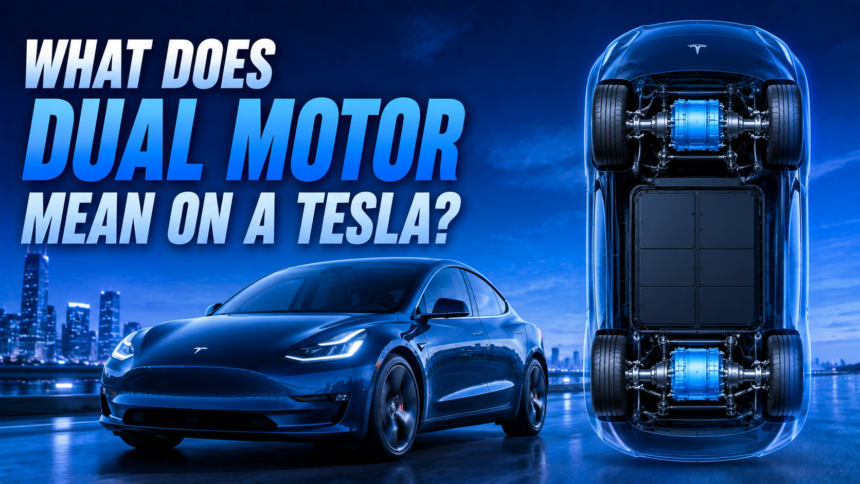
If you’ve been shopping for a Tesla, you’ve probably come across the term “Dual Motor” attached to a higher trim level with a bigger price tag. So what does dual motor mean on a Tesla, exactly, and is it worth paying extra for? In simple terms, a dual motor Tesla has two separate electric motors instead of one — one motor drives the front wheels, and the other drives the rear wheels. This setup gives the car all-wheel drive, quicker acceleration, and better grip on the road.
- What Does Dual Motor Actually Mean?
- How Dual Motor All-Wheel Drive (AWD) Works
- Dual Motor vs Single Motor Tesla
- Benefits of Dual Motor Tesla
- Drawbacks of Dual Motor Tesla
- Which Tesla Models Offer Dual Motor?
- Dual Motor vs Tri Motor (Plaid) — Brief Comparison
- Is Dual Motor Worth the Extra Cost?
- Frequently Asked Questions (FAQ)
- Conclusion
- Related Articles
This feature matters a lot to buyers because it directly affects how the car performs in everyday driving, how it handles bad weather, and how much it costs both upfront and over time. Nearly every current Tesla model — the Model 3, Model Y, Model S, Model X, and Cybertruck — offers a dual motor option, and understanding what it actually does can help you decide whether it fits your needs and budget.
What Does Dual Motor Actually Mean?
At its core, the answer to “what does dual motor mean on a Tesla” is straightforward: instead of relying on one electric motor to move the car, Tesla installs two independent motors — one at the front axle and one at the rear axle. Each motor can operate on its own, sending power to its own set of wheels.
This is different from a single motor Tesla, which only has one motor, usually mounted at the rear, powering just the rear wheels. A single motor car is rear-wheel drive (RWD), while a dual motor car is all-wheel drive (AWD).
It’s also worth remembering that Teslas don’t use a traditional gasoline engine, transmission, or fuel system at all. Everything is electric. So when we talk about “motors,” we’re talking about compact electric drive units that convert battery power into motion almost instantly, with no gears to shift and no engine warm-up needed. Adding a second motor simply means the car has two of these units working together instead of one.
How Dual Motor All-Wheel Drive (AWD) Works
Understanding how the two motors work together helps explain why dual motor Teslas feel so different to drive.
The front motor is responsible for turning the front wheels. It’s generally tuned for efficiency and smoother, controlled power delivery, since the front end of the car handles a lot of steering and stability work.
The rear motor handles the rear wheels and is usually the primary source of power, especially during hard acceleration. In many Tesla models, the rear motor does more of the heavy lifting when you press the accelerator firmly.
What makes this system smart is how power gets split between the two axles. Tesla’s onboard computer constantly monitors road conditions, wheel slip, steering input, and acceleration in real time — many times per second. If the rear wheels start to lose traction on a wet or icy road, the system can instantly shift more power to the front wheels, and vice versa. This happens automatically, without the driver noticing anything except that the car feels planted and stable.
This real-time torque distribution is really the heart of what makes dual motor Teslas so capable in varied driving conditions, from dry highways to snowy backroads.
Dual Motor vs Single Motor Tesla
To fully grasp what does dual motor mean on a Tesla, it helps to compare it directly against the single motor version.
Performance: Dual motor cars accelerate noticeably faster because both motors contribute power simultaneously, rather than one motor doing all the work.
Range: Single motor Teslas often get slightly better range per charge because they carry less weight and have less mechanical drag from a second motor.
Price: Dual motor trims cost more, typically several thousand dollars above the single motor version of the same model.
Traction and handling: Dual motor cars grip the road better in rain, snow, and rough conditions because power reaches all four wheels instead of just two.
Here’s a simple side-by-side comparison:
| Feature | Single Motor (RWD) | Dual Motor (AWD) |
|---|---|---|
| Drive Type | Rear-wheel drive | All-wheel drive |
| Acceleration | Slower | Faster |
| Driving Range | Slightly higher | Slightly lower |
| Price | Lower | Higher |
| Wet/Snow Traction | Reduced | Improved |
| Towing Capability | Limited or none | Better suited |
| Best For | Mild climates, budget buyers | Varied weather, performance seekers |
Benefits of Dual Motor Tesla
There are several real advantages that come with choosing a dual motor Tesla.
Faster acceleration is one of the most noticeable perks. Because two motors are working together, dual motor Teslas typically post quicker 0-60 mph times than their single motor counterparts, sometimes by a full second or more.
Better traction in rain, snow, and ice is another major benefit. Since power reaches all four wheels, the car is less likely to slip or struggle for grip when roads get slippery, which is especially valuable for drivers in colder or wetter climates.
Improved handling and cornering come from the balanced power distribution between the front and rear axles, which helps the car stay composed through curves and quick maneuvers.
Added safety in bad weather ties directly into the traction benefits — better grip generally means more predictable, controlled driving when conditions turn rough.
Towing capability also improves with dual motor setups, since the added power and traction make it easier to pull trailers or heavier loads without straining the drivetrain.
Drawbacks of Dual Motor Tesla
Dual motor isn’t automatically the right choice for everyone, and it does come with a few trade-offs.
The higher price tag is the most obvious downside. Dual motor trims sit above single motor versions, so buyers need to weigh whether the extra performance and traction are worth the added cost.
Slightly reduced range compared to single motor versions is another factor, since the second motor and its extra components add weight and use a bit more energy overall.
Higher cost of ownership can also come into play. Dual motor Teslas often ride on higher-performance tires that may wear faster or cost more to replace, and general upkeep can be marginally higher due to the additional hardware.
Which Tesla Models Offer Dual Motor?
Nearly every Tesla currently sold offers a dual motor configuration:
- Model 3 Dual Motor – Available as a higher trim above the standard rear-wheel drive version, offering quicker acceleration and AWD.
- Model Y Dual Motor – One of the most popular configurations, balancing everyday practicality with added traction.
- Model S Dual Motor – Comes standard with dual motor AWD across most trims, known for strong performance.
- Model X – Typically ships as standard with dual motor AWD, reflecting its SUV positioning.
- Cybertruck Dual Motor – Offered as a mid-tier option, giving the truck stronger towing and off-road capability.
Dual Motor vs Tri Motor (Plaid) — Brief Comparison
For buyers curious about Tesla’s top-tier performance options, it’s worth understanding how tri motor “Plaid” versions differ from dual motor.
Tri motor setups add a third motor, usually giving even more power to the rear axle for extreme acceleration figures. This is aimed at drivers chasing the fastest possible performance numbers, not just solid everyday capability.
Dual motor is enough for the vast majority of drivers who want strong acceleration, AWD traction, and a good balance of range and cost. Tri motor Plaid versions make more sense for those specifically prioritizing top-end performance and are willing to pay a significant premium for it.
Is Dual Motor Worth the Extra Cost?
Whether dual motor is worth it really comes down to your climate and driving habits.
Drivers in areas with regular rain, snow, or icy roads tend to benefit the most from the added traction and stability dual motor provides. Those who tow trailers, drive frequently on unpaved roads, or simply want quicker acceleration for merging and passing will also likely find the upgrade worthwhile.
On the other hand, budget-focused buyers in mild, dry climates who mainly drive around town may find that a single motor Tesla covers their needs just fine, while saving money upfront and gaining a bit of extra range.
Frequently Asked Questions (FAQ)
Is dual motor the same as AWD? Yes. On a Tesla, dual motor and all-wheel drive refer to the same thing — two motors powering both axles.
Does dual motor reduce range? Slightly. The extra weight and components of a second motor typically result in a modest decrease in range compared to a single motor version of the same model.
Can you upgrade from single to dual motor later? No. Motor configuration is set at the time of purchase and cannot be added afterward, since it requires different hardware built into the car.
Is dual motor safer in snow? Generally, yes. The improved traction from powering all four wheels helps the car maintain better grip and control in snowy or icy conditions compared to a single motor rear-wheel-drive setup.
Does dual motor need more maintenance? Not significantly, though tires may wear differently due to the added performance, and there are simply more components involved overall.
Conclusion
So, what does dual motor mean on a Tesla? It means the car has two electric motors — one for the front wheels and one for the rear — working together to deliver all-wheel drive, faster acceleration, and stronger traction in tough conditions. While it comes at a higher price and a small trade-off in range, it offers real advantages for drivers dealing with rain, snow, towing needs, or anyone who simply wants a quicker, more capable Tesla. Choosing between single and dual motor ultimately comes down to your climate, driving style, and budget.
Related Articles
How to Turn Off Tesla Location Sharing: Complete Step-by-Step Guide
Are Honda Accords All Wheel Drive? Full Drivetrain Guide
How to Repair a Cracked Car Dashboard: Complete DIY Guide
What Type of Gas Does a Honda Accord Take? Complete Fuel Guide