


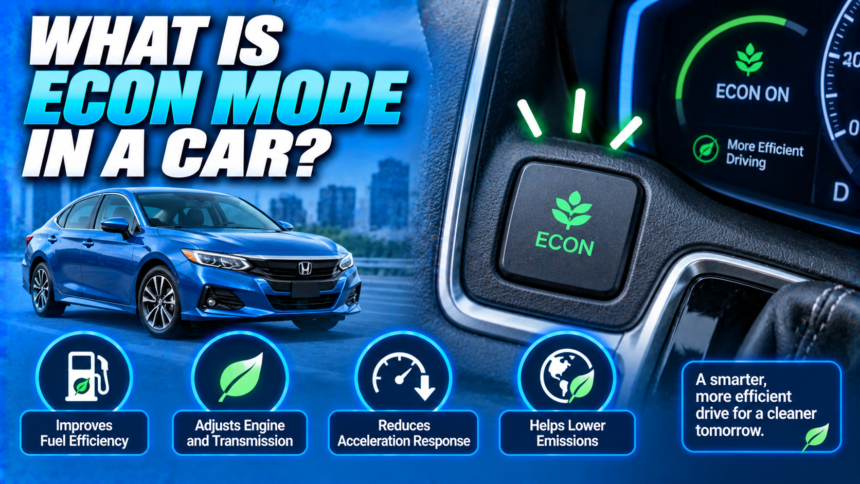
Econ mode is a button that retunes your car to use less fuel. Press it and the engine responds more gently to the pedal, the transmission shifts up sooner and holds a higher gear, and the air conditioning eases off. Nothing mechanical changes. It is a software setting, and you can switch it off at any time.
- What Econ mode actually changes
- Why softening the pedal saves anything
- How much fuel does Econ mode really save?
- Which cars have it, and what it is called
- Where the button is and how to turn it on
- Does Econ mode make the car unsafe?
- When to use it and when to turn it off
- Is Econ mode bad for your engine?
- Econ mode, the Eco light, and hybrid modes
- Conclusion
- Frequently asked questions
- Related Articles
Honda calls it ECON. Most other brands call the same idea Eco. Whatever the label, the button is asking your car to trade a bit of eagerness for a bit of economy, and the amount you get back depends far more on how you were driving before you pressed it than on the button itself.
What Econ mode actually changes
The system works four or five levers at once, all through the engine and transmission computers.
Throttle response. The pedal becomes less sensitive in its middle range. Push it halfway and you get less than half the power you would have got before. Off the line and at full pedal, the response is mostly unchanged.
Shift points. The transmission upshifts earlier and resists downshifting, holding the engine at lower revs for longer. On a car with a CVT, the effect is the same: the ratio moves to keep the engine turning slowly.
Air conditioning. The compressor cycles off more often and the fan works less hard. Cabin temperature swings a little more as a result, which is the real cost of this one on a hot day.
Cruise control. On many cars the system stops downshifting to hold your set speed on a climb. Your speed sags a couple of miles per hour going up a hill and recovers gradually on the other side.
Idle stop. On cars fitted with automatic engine stop, Econ mode often extends how long the engine stays off at a red light.
Some cars also dim interior lighting or trim power to heated seats, though those savings are tiny next to the throttle and the compressor.
Why softening the pedal saves anything
This is the part most explanations skip, and it is the part that makes sense of everything else.
Fuel is wasted in the moments of hard acceleration, not in the cruising. The US Department of Energy puts numbers on it: aggressive driving, meaning speeding along with rapid acceleration and braking, lowers gas mileage by roughly 15 to 30 percent at highway speeds and by 10 to 40 percent in stop-and-go traffic. That is an enormous range of waste, and all of it sits in your right foot.
Econ mode is a governor on that foot. It cannot stop you accelerating hard, but it makes hard acceleration take deliberate effort rather than happening by accident every time a light turns green. For a driver with a heavy foot in city traffic, that is where the savings live. For someone who already accelerates gently and cruises at a steady speed, there is much less left to reclaim.
How much fuel does Econ mode really save?
Honestly, less than the button implies, and it varies enormously.
Carmakers do not publish a figure for it, because the answer depends on the driver. The closest useful benchmark comes from the fuel-economy feedback systems that usually ship alongside these modes: the Department of Energy notes that feedback of this kind improves the average driver’s fuel economy by about 3 percent, and by around 10 percent for drivers actively using it to save fuel. You can read the underlying advice on the government’s driving efficiently guide.
Treat single-digit percentages as the realistic expectation. On a car returning 30 mpg, a 5 percent gain is about 1.5 mpg, which over 12,000 miles a year is roughly 20 gallons. Worth having, not life-changing.
Where the mode earns its keep quietly is the air conditioning. A compressor is a real mechanical load on the engine, and it runs hardest in exactly the slow city traffic where fuel economy is already worst. Cycling it off more often is a small, steady saving that costs you nothing on a mild day and a little comfort on a hot one.
The way to find your own number is to measure it. Fill the tank, reset the trip computer, drive a normal week with Econ on, then repeat the same week with it off. Two tanks will tell you more than any published estimate.
Which cars have it, and what it is called
The feature is common but not universal, and the name changes from brand to brand.
Honda and Acura use ECON, with a dedicated button. Honda’s own owner documentation describes it as adjusting the performance of the engine, transmission, and climate control system, and notes that cabin temperature fluctuates more while it is on, which matches what drivers feel on a hot day. You can read the ECON button entry in Honda’s owner’s manual for the exact wording.
Toyota and Lexus use Eco as one position on a drive mode selector, alongside Normal and Sport, and on some models the mode also trims energy going to heating, cooling, and seat heaters. Ford, Chevrolet, Hyundai, Kia, Nissan, and Volvo have all offered an Eco setting of some kind, though never across every model in the range.
Two things follow from that. First, the details differ, so your car’s manual is the only place with an exact list of what changes. Second, an absent button does not mean an inefficient car. Plenty of vehicles simply have one calibration tuned for economy from the start.
Where the button is and how to turn it on
On a Honda it is usually a green button marked ECON on the dashboard to the left of the wheel or near the gear selector, sometimes with a leaf symbol. Press it once and a green indicator appears in the instrument cluster.
Other brands bury the same setting in a drive mode selector, a dial or rocker offering Eco, Normal, Sport, and sometimes Snow or Individual. Turning to Eco does the same job as pressing ECON.
Check whether the setting survives a restart. Some cars remember Econ mode and come back on it every time you start; others reset to Normal at every key cycle. If your mileage seems inconsistent, this is often why.
You can switch modes while moving. There is no need to stop, and the change takes effect immediately.
Does Econ mode make the car unsafe?
No, and this is worth being clear about, because it is the most common worry.
Full power stays available. Econ mode remaps the middle of the pedal travel, not the end of it. Press the accelerator all the way down and the car delivers everything the engine has, downshifts included. Merging onto a highway, overtaking, or getting out of trouble all still work; you simply have to press further than you are used to.
What does change is the feel. A gap you used to take with a light squeeze of the pedal now needs a firmer push. That mismatch between habit and response is the real hazard, and it disappears after a few days of driving in the mode. If it does not, turn the mode off. A car that responds the way you expect is worth more than a few tenths of a mile per gallon.
When to use it and when to turn it off
| Situation | Econ mode |
| City traffic, commuting, school runs | Leave it on |
| Steady highway cruising | Leave it on |
| Merging onto a fast highway | Fine, press the pedal further |
| Towing a trailer or loaded heavily | Turn it off |
| Long mountain climbs | Turn it off |
| Very hot weather with a hot cabin | Turn it off until the cabin cools |
| Snow, ice, or deep mud | Turn it off, or use the dedicated mode |
The towing and mountain cases matter most. When the engine genuinely needs to work, a system built to keep revs low fights you, and the transmission can end up hunting between gears, which wastes more fuel than the mode saves. The hot-weather case is about comfort: get the cabin cool with the mode off, then switch it back on to hold the temperature.
Is Econ mode bad for your engine?
No. Every rev range Econ mode uses is a normal operating range that the engine was designed and tested for. Lower revs mean less friction, less heat, and fewer combustion cycles per mile, none of which shortens engine life.
The one habit worth avoiding has nothing to do with the button. Engines that only ever run short, gentle, cold trips can build up deposits over time, and that is true whether Econ mode is on or off. A regular longer drive at normal running temperature takes care of it.
Transmission wear is not a concern either. Earlier upshifts mean fewer shift events, not more.
Econ mode, the Eco light, and hybrid modes
Three different green things on a dashboard get confused with each other.
Econ or Eco mode is the button you press. It changes how the car behaves.
The Eco indicator or coaching display is the bar, leaf, or glowing ring that grows when you drive gently. It changes nothing about the car. It is a score, and it works by telling you what your foot is doing.
Hybrid and EV modes are a different category. EV mode on a plug-in hybrid asks the car to run on battery alone. B mode or a regeneration paddle increases braking recovery. These move energy around rather than softening the throttle, and a hybrid can have both an Eco mode and an EV mode doing separate jobs.
Conclusion
Econ mode is a software setting that softens the throttle, shifts up earlier, and eases the air conditioning to save fuel. Expect a single-digit percentage gain, more if you have a heavy foot and drive in traffic, less if you already drive gently. Leave it on for commuting and cruising, switch it off for towing, steep climbs, and cooling a hot cabin, and remember that full power is still one firm pedal press away.
Frequently asked questions
Should I always drive in Econ mode?
For everyday commuting and highway cruising, yes, it costs you nothing but a slightly softer pedal. Switch it off when towing, climbing long grades, or cooling a hot cabin quickly, and switch it back on afterwards.
Does Econ mode make your car slower?
It makes the car feel slower in the middle of the pedal travel, but top speed and full acceleration are unchanged. Press the accelerator all the way down and you get the engine’s full output, downshifts included.
How much gas does Econ mode save?
Realistically a few percent, occasionally close to 10 percent for a driver with heavy habits in city traffic. The gain comes from smoothing out hard acceleration, so gentle drivers see very little change.
Does Econ mode damage the engine or transmission?
No. It keeps the engine in normal operating ranges and produces fewer gear changes, not more. There is no added wear from using it, and no need to alternate it with any other mode.
Does Econ mode stay on after I turn the car off?
It depends on the car. Some models remember the setting between drives and others reset to Normal at every start. Check the indicator in your instrument cluster the next time you set off.
Related Articles
What to Do With Old Car Seats?
How Many Engine Mounts Does a Car Have?