


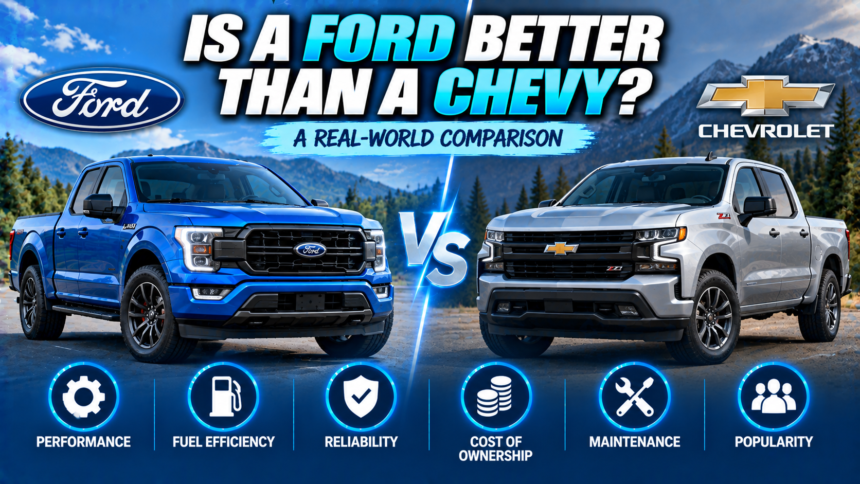
Few debates in the automotive world are as long-running as Ford versus Chevy. Walk into any garage, truck stop, or family gathering, and you’re bound to hear someone defend their brand with fierce loyalty. But when people actually ask is a Ford better than a Chevy, the honest answer isn’t a simple yes or no — it depends on what you drive, how you drive it, and what matters most to you as an owner. In this guide, we’ll break down everything from history and design to reliability, resale value, and technology, so you can make an informed decision instead of relying on brand loyalty alone.
- A Brief History of Ford and Chevy
- Ford vs Chevy: Key Differences at a Glance
- Ford vs Chevy Trucks Comparison
- Ford vs Chevy SUVs Comparison
- Reliability & Maintenance Cost Comparison
- Resale Value: Ford vs Chevy
- Technology & Infotainment Comparison
- Pros and Cons of Ford
- Pros and Cons of Chevy
- Which One Should You Buy?
- Frequently Asked Questions (FAQs)
- Conclusion
- Related Articles
A Brief History of Ford and Chevy
History of Ford
Ford Motor Company was founded by Henry Ford in 1903 and quickly became a symbol of American industrial innovation. Ford is credited with popularizing the moving assembly line, which made cars more affordable for everyday families. Over the decades, Ford built a reputation around trucks, with the F-150 becoming the best-selling vehicle in America for years running. The brand has positioned itself as rugged, work-focused, and innovation-driven, especially with its recent push into electric trucks and SUVs.
History of Chevrolet
Chevrolet, often just called “Chevy,” was founded in 1911 by Louis Chevrolet and William Durant. It later became a core division of General Motors. Chevy built its identity around offering dependable, accessible vehicles for the average American household, while also carving out a performance niche with cars like the Corvette and Camaro. Chevy trucks, especially the Silverado, have long competed head-to-head with Ford for dominance in the truck market.
Brand Philosophy & Market Positioning
Ford tends to market itself around toughness and “Built Ford Tough” messaging, emphasizing durability and work capability. Chevy leans more into versatility, smooth ride quality, and a broader lineup that spans from budget-friendly compacts to high-performance sports cars. Neither philosophy is superior — they simply appeal to different priorities.
Ford vs Chevy: Key Differences at a Glance
Before diving deeper, it helps to see how the two brands stack up on the basics.
| Category | Ford | Chevy |
|---|---|---|
| Known For | Trucks, towing capacity | Ride comfort, engine variety |
| Popular Models | F-150, Explorer, Escape | Silverado, Tahoe, Equinox |
| Infotainment | Ford Sync | Chevy MyLink |
| Price Range | Slightly higher on trims | Often more budget-friendly |
| Resale Value | Strong on trucks | Moderate, varies by model |
Design & Build Quality
Ford vehicles are often praised for their bold, angular exterior styling and utilitarian interior design, particularly in truck models. Chevy, on the other hand, is frequently noted for offering a quieter cabin and smoother ride, especially in its SUVs and trucks. Build quality between the two brands is generally comparable, though specific model years can vary based on manufacturing changes and recalls.
Engine Performance
Ford’s EcoBoost engine lineup has earned a strong reputation for balancing power with fuel efficiency, particularly in the F-150. Chevy counters with its dependable small-block V8 engines, which many truck owners praise for long-term durability and towing consistency. If raw horsepower and towing numbers matter most to you, it’s worth comparing specific trims rather than judging by brand alone.
Pricing Comparison
In general, Chevy trims tend to start slightly lower in price than comparable Ford models, though this gap can shrink or disappear depending on promotions, region, and dealership. Ford often justifies a higher starting price with additional standard tech features in some trims.
Ford vs Chevy Trucks Comparison
Trucks are where this rivalry is most intense, since both brands built their reputations on hauling and towing capability.
F-150 vs Silverado
The Ford F-150 and Chevy Silverado are consistently the two best-selling trucks in America, and comparisons between them dominate the “is a Ford better than a Chevy” conversation. The F-150 is often praised for its lighter aluminum body, which can improve fuel economy and reduce rust-related wear over time. The Silverado counters with a strong lineup of V8 engine options and a reputation for a smoother highway ride.
Towing & Payload Capacity
Towing capacity varies significantly by trim and engine configuration on both trucks, so it’s misleading to say one brand universally tows more. In top-tier configurations, both the F-150 and Silverado can tow well over 11,000 pounds, making either a solid choice for serious hauling needs.
Fuel Efficiency
Thanks to its aluminum body and EcoBoost engines, the F-150 often has a slight edge in fuel economy compared to similarly equipped Silverado trims. However, the gap is generally small and may not be the deciding factor for most buyers.
Ford vs Chevy SUVs Comparison
Explorer vs Tahoe
The Ford Explorer and Chevy Tahoe serve slightly different buyer needs. The Explorer tends to offer a more car-like driving experience with strong third-row usability, while the Tahoe leans into full-size SUV territory with greater cargo and towing capacity.
Interior Comfort & Tech Features
Chevy SUVs are frequently noted for quieter cabins and comfortable seating, while Ford SUVs tend to offer a more modern, tech-forward dashboard layout, especially in newer trims with larger touchscreen displays.
Safety Ratings
Both brands generally perform well in crash safety testing, though specific ratings vary by model year and trim. It’s always worth checking the latest IIHS or NHTSA ratings for the exact model you’re considering, since safety tech changes yearly.
Reliability & Maintenance Cost Comparison
Long-Term Reliability
Reliability rankings between Ford and Chevy fluctuate year to year depending on the model. Some Chevy engines, particularly certain V8 configurations, have built a long-term reputation for dependability. Ford has made significant reliability improvements in recent years, though some EcoBoost engines have had documented issues with turbocharger components in earlier model years.
Common Issues Reported
Owners of both brands report occasional electrical and infotainment glitches. Ford trucks have had some documented transmission concerns in specific years, while Chevy trucks have occasionally faced issues with certain fuel injector systems. As with most reliability discussions, the specific model year matters far more than the brand name alone.
Maintenance & Repair Costs
Maintenance costs tend to be fairly comparable between the two brands, though Chevy parts are sometimes slightly cheaper due to broader third-party parts availability. Labor costs will vary more by your local dealership or mechanic than by brand.
Resale Value: Ford vs Chevy
Depreciation Rates
Trucks from both brands tend to hold value better than sedans or smaller SUVs, but Ford trucks — particularly the F-150 — have historically shown strong resale value due to consistent demand.
Which Brand Holds Value Better
While Ford trucks often edge out in resale percentage retained, Chevy trucks remain highly desirable in the used market, especially models known for strong engine reliability. The resale gap between the two is often narrower than brand loyalists assume.
Technology & Infotainment Comparison
Ford Sync vs Chevy MyLink
Ford’s Sync infotainment system is generally regarded as intuitive and responsive, with smooth smartphone integration. Chevy’s MyLink system offers similar functionality, with many users finding it equally easy to navigate, though interface preferences often come down to personal taste.
Driver-Assist Features
Both brands offer a solid suite of driver-assist technology, including lane-keeping assist, adaptive cruise control, and forward collision warnings on most modern trims. Higher trims from both brands tend to include more advanced semi-autonomous features.
Pros and Cons of Ford
Advantages
- Strong towing and payload options across truck trims
- Aluminum body on F-150 can improve fuel efficiency and rust resistance
- Bold, modern tech features in newer models
- Strong resale value on popular truck models
Disadvantages
- Some EcoBoost engines have had turbocharger reliability concerns
- Higher starting price on certain trims
- Aluminum body repairs can be more expensive after collision damage
Pros and Cons of Chevy
Advantages
- Smooth, comfortable ride quality
- Reliable V8 engine options with a long track record
- Often more budget-friendly starting price
- Wide model lineup across price points
Disadvantages
- Some fuel injector issues reported in certain model years
- Interior styling can feel less modern compared to Ford in some trims
- Resale value slightly behind Ford trucks in some markets
Which One Should You Buy?
Best for Towing/Work
If heavy-duty towing and work-site durability are your top priorities, both the F-150 and Silverado are excellent choices — but the F-150’s aluminum body may give it a slight edge in long-term rust resistance for work trucks exposed to harsh conditions.
Best for Daily Commute
For daily commuting comfort, Chevy’s smoother ride quality and quieter cabin make models like the Equinox or Tahoe appealing choices for everyday driving.
Best for Budget Buyers
If your top priority is getting the most value for a lower starting price, Chevy trims often provide more affordable entry points without sacrificing core reliability.
Frequently Asked Questions (FAQs)
Is Ford more reliable than Chevy?
Reliability depends heavily on the specific model and year rather than the brand as a whole. Some Ford models outperform Chevy in reliability rankings, while certain Chevy engines have a long-standing reputation for dependability.
Which has a better resale value?
Ford trucks, particularly the F-150, have historically shown stronger resale value, though the difference compared to Chevy trucks is often modest.
Which truck tows more, F-150 or Silverado?
Towing capacity depends on the specific trim and engine configuration. Top trims from both trucks can tow well over 11,000 pounds, making them closely matched.
Which is cheaper to maintain?
Maintenance costs are generally comparable between the two brands, with minor cost differences depending on parts availability and local labor rates.
Conclusion
So, is a Ford better than a Chevy? The honest answer is that it depends entirely on your priorities. Ford tends to edge out in aluminum-body durability, fuel efficiency, and tech-forward interiors, while Chevy often wins on ride comfort, engine dependability, and starting price. Rather than choosing based on brand loyalty alone, it’s worth comparing the exact models, trims, and model years you’re considering — and ideally test-driving both before making your final decision.
Related Articles
How to Remove Tree Sap From a Car Without Damaging the Paint?
How to Get Water Stains Off Car Windows?