



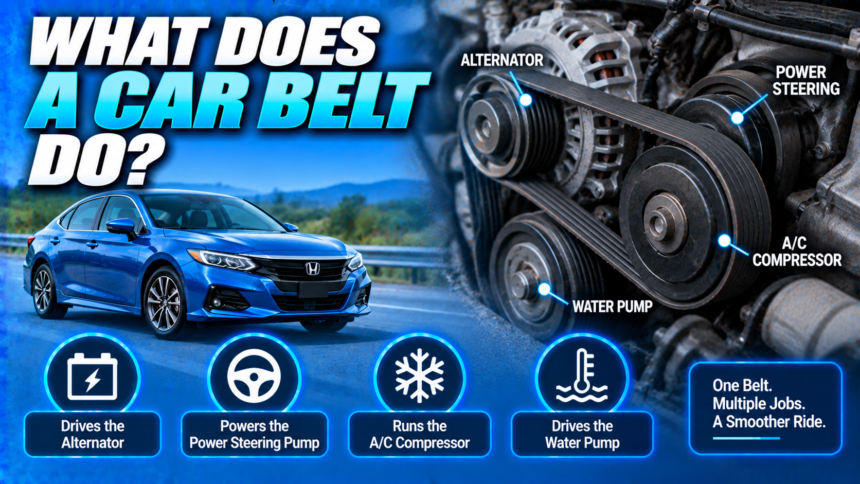
A car belt uses the power of the spinning engine to drive other parts of the car. Most cars have two belts, and they do very different jobs. The serpentine belt (also called the drive belt) powers accessories like the alternator, power steering, and air conditioning. The timing belt works inside the engine, keeping its moving parts perfectly in sync so it runs at all.
Knowing which belt is which matters, because one can leave you stranded while the other can wreck your engine. Here is what each belt does, how to spot a worn one, and when to replace them.
The serpentine belt: powering the accessories
The serpentine belt is the long, winding belt you can see when you open the hood. It gets its name because it snakes around a series of pulleys, much like a serpent. The engine’s crankshaft turns it, and as it loops around the engine it drives several important accessories at once.
A single serpentine belt typically powers:
- The alternator, which charges the battery and runs the car’s electrics.
- The power steering pump, which makes the steering wheel easy to turn.
- The air conditioning compressor, which cools the cabin.
- The water pump, on many cars, which circulates coolant to stop the engine overheating.
Older cars used a separate belt for each of these. If one failed, you lost only that one accessory. The trouble was that several belts waste engine power to friction, so carmakers combined them into one serpentine belt. That is more efficient, but it means a single belt now runs everything, and if it breaks, all those systems stop together.
When a serpentine belt snaps, the alternator stops charging, the power steering goes heavy, the AC dies, and if that belt also drives the water pump, the engine can overheat fast. The engine itself usually is not damaged, but you will need to pull over.
The timing belt: keeping the engine in sync
The timing belt does something completely different and far more delicate. It is a shorter, toothed belt tucked inside the engine behind a cover, so you cannot see it without taking parts off. Its job is timing, exactly as the name says.
Inside the engine, two shafts must turn in perfect step: the crankshaft (driven by the pistons) and the camshaft (which opens and closes the valves). The timing belt links them and keeps them synchronized, so the valves open and close at precisely the right instant relative to the pistons moving up and down. Get that timing even slightly wrong and the engine runs badly or not at all.
This is why a timing belt failure is so serious. On what is called an interference engine, which covers most modern cars, the valves and pistons share the same space at different moments. If the belt snaps and timing is lost, they can collide, bending valves and damaging pistons. As Tires Plus explains, a broken timing belt can shut the engine down entirely, and the repair can be far more expensive than the belt itself.
The two belts side by side
Here is the clearest way to see how the two belts differ:
| Serpentine (drive) belt | Timing belt | |
| Its job | Powers accessories: alternator, power steering, AC, often the water pump | Keeps the crankshaft and camshaft in sync so valves open at the right moment |
| Where it is | On the outside of the engine, easy to see | Deep inside the engine, behind a cover |
| Look | Long, flat, ribbed belt that snakes around pulleys | Shorter belt with teeth that grip gears |
| If it breaks | Accessories stop; car may overheat, but the engine usually survives | On most modern engines, serious internal damage |
| When to replace | Roughly 60,000 to 100,000 miles, or when worn | Roughly 60,000 to 100,000 miles; follow the manual exactly |
The short version: the serpentine belt is about comfort and convenience, and the timing belt is about the engine surviving. Both matter, but they fail in very different ways.
Timing belt or timing chain?
Not every car has a timing belt. Many engines use a timing chain instead, which does the exact same job of syncing the crankshaft and camshaft, but is built from metal links like a bicycle chain rather than reinforced rubber.
The practical difference is maintenance. A timing chain is more durable and is often designed to last the life of the engine, so it usually does not need scheduled replacement. A timing belt is made of rubber and wears out, so it must be replaced on a set schedule. If you are not sure which your car has, the owner’s manual or a mechanic can tell you, and it is worth knowing, because a belt has a replacement deadline and a chain generally does not.
Signs your belt is wearing out
The serpentine belt usually gives you warning before it fails, so it pays to know the signs:
- Squealing or chirping noises from the front of the engine, often loudest on startup or when you turn the wheel.
- Visible cracks, fraying, or a glazed, shiny surface on the belt, which you can often see with the engine off.
- Warning signs of failing accessories, such as a dead or weak battery (alternator), heavy steering (power steering pump), or the engine running hot (water pump).
The timing belt is the tricky one: it often gives no warning at all before it breaks. That is exactly why you replace it on schedule rather than waiting for a symptom.
If you hear a persistent squeal or see a cracked belt, get it inspected soon. A belt is a small, relatively cheap part, and replacing it before it fails is far cheaper than dealing with the fallout of a break.
When to replace a car belt?
Both belts have rough service lives, but your owner’s manual has the exact numbers for your car, and those come first. As a general guide, a serpentine belt is often replaced somewhere around 60,000 to 100,000 miles, or sooner if it is cracked or noisy. A timing belt falls in a similar range, commonly around 60,000 to 100,000 miles.
The difference is how strict you should be. With the serpentine belt you have some warning, so you can react to symptoms. With the timing belt there is usually no warning, so treat the manufacturer’s interval as a hard deadline. Replacing a timing belt is a bigger, pricier job because of the labor to reach it, but it is a small fraction of the cost of a wrecked engine. Many shops replace the water pump at the same time, since it is already apart, which saves money later.
Conclusion
A car belt uses the engine’s spin to drive other parts, and most cars have two. The serpentine belt powers accessories like the alternator, power steering, and AC, and a break leaves you stranded but usually spares the engine.
The timing belt keeps the engine’s internals in sync, and on most modern cars a break causes serious damage. Watch for squeals and cracks on the serpentine belt, and replace the timing belt on schedule, since it rarely warns you first. Check your manual for the exact intervals.
Frequently asked questions
What is the difference between a serpentine belt and a timing belt? The serpentine belt powers external accessories like the alternator and AC. The timing belt sits inside the engine and keeps the crankshaft and camshaft in sync. Different jobs, different locations.
What happens if my car belt breaks? If the serpentine belt breaks, accessories stop and the car may overheat, but the engine usually survives. If the timing belt breaks on most modern engines, it can cause serious internal engine damage.
How do I know if my belt is worn? Listen for squealing from the front of the engine and look for cracks, fraying, or a shiny glazed surface on the serpentine belt. Timing belts often give no warning, so replace them on schedule.
How often should a car belt be replaced? Both belts are often replaced somewhere around 60,000 to 100,000 miles, but your owner’s manual has the exact interval for your car. Follow the timing belt schedule strictly.
Does every car have a timing belt? No. Many engines use a timing chain instead, which does the same job but is made of metal and usually lasts the life of the engine without scheduled replacement. Check your manual to see which you have.
Related Articles
Does Driving a Car Charge the Battery? What to Know
How Long Can a Car Sit Before the Battery Dies?
How Many Engine Mounts Does a Car Have?
How Much Oil to Put in Your Car: Quarts by Engine?