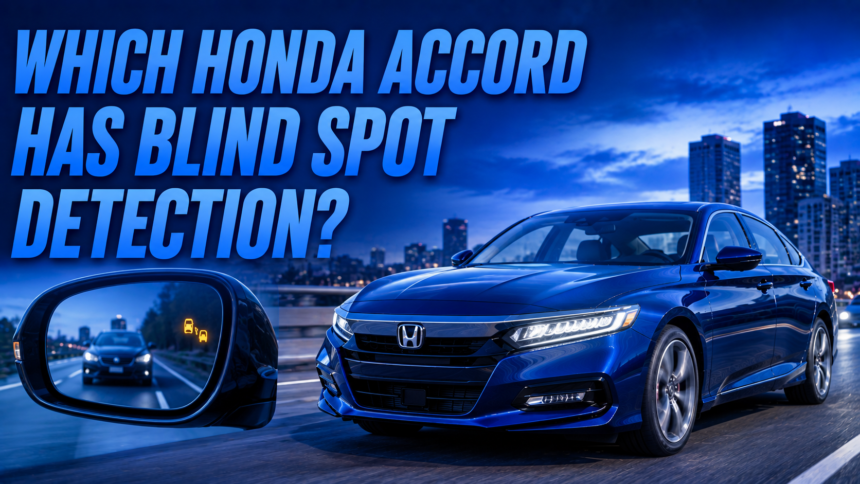
If you’re shopping for a Honda Accord and safety is high on your checklist, there’s a good chance you’ve typed “which Honda Accord has blind spot detection” into a search bar at some point. It’s a fair question, because Honda hasn’t offered this feature the same way across every model year and trim.
- A Quick Answer Before We Dive In
- What Is Honda’s Blind Spot Information System (BSI)?
- Blind Spot Detection by Accord Generation and Year
- Honda Accord Hybrid vs. Gas Models
- How to Check If Your Specific Accord Has BSI
- Can You Add Blind Spot Detection to an Accord That Doesn’t Have It?
- BSI and the Rest of Honda Sensing®
- Is Blind Spot Detection Worth Paying For?
- Frequently Asked Questions
- Final Thoughts
- Related Articles
Some Accords come with it standard, some only offer it as part of a pricier trim, and older models may not have it at all. This guide walks you through everything you need to know in plain language, so you can figure out exactly what you’re getting before you sign any paperwork.
A Quick Answer Before We Dive In
In short, Honda began adding blind spot detection to the Accord lineup in 2018, but for several years it was reserved for the higher trims like EX-L and Touring.
That changed gradually as Honda moved the feature further down the trim ladder. By 2023, it had become standard on the EX trim and above, and starting with the 2025 model year, Honda made it standard on the SE trim and up, putting it within reach of far more buyers. If you want the full picture, including hybrid models and how to double-check your own car, keep reading.
What Is Honda’s Blind Spot Information System (BSI)?
Honda’s blind spot detection technology is officially called the Blind Spot Information System, or BSI for short. It’s designed to solve a problem every driver knows well: no matter how carefully you adjust your mirrors, there’s always a small pocket of space next to your car that stays hidden from view. That hidden zone is where accidents during lane changes most often happen.
BSI works using a pair of radar sensors mounted at the rear corners of the vehicle. These sensors continuously scan the lanes next to and slightly behind the Accord while you’re driving. When another vehicle enters that zone, a small light illuminates on the corresponding side mirror, letting you know something is there before you even think about changing lanes. If you switch on your turn signal while a vehicle is detected in that blind spot, the system steps up its warning, the light on the mirror starts flashing and an audible chime sounds inside the cabin, so it’s hard to miss.
It’s worth pointing out how this differs from the older LaneWatch system that Honda used on many models before BSI came along. LaneWatch relied on a camera mounted under the passenger-side mirror that streamed a live video feed of your blind spot onto the dashboard screen whenever you signaled a right turn. It was useful, but it only covered one side of the car and required you to glance at a screen rather than getting a simple, instant visual cue. BSI, by contrast, covers both sides of the vehicle at once and uses radar rather than a camera, which tends to perform more consistently in poor lighting or bad weather.
Blind Spot Detection by Accord Generation and Year
Since Honda has changed which trims include BSI almost every couple of years, it helps to break things down generation by generation.
2018 to 2020 Accords mark the beginning of BSI’s rollout on this model. During these years, the feature was generally limited to the upper trims, meaning EX-L and Touring buyers got it while those who chose LX, Sport, or base EX trims typically had to go without, unless they opted for the LaneWatch camera setup where available. If you’re shopping the used market and considering one of these model years, it’s especially important to verify the trim carefully, since a Sport trim from this era usually will not have blind spot detection at all.
2021 and 2022 Accords continued along a similar pattern but expanded availability slightly. For the 2021 model year, blind spot detection was offered on the EX-L and Touring trims. By 2022, Honda extended it a bit further, making it available on the Sport and EX-L trims, with it remaining standard on Touring models. This was a meaningful shift, since Sport trims are among the more popular choices for buyers who want a sportier look without paying for the top-tier Touring package.
2023 and 2024 Accords represent a turning point. Honda restructured the Accord’s trim lineup for this generation, and BSI became standard starting at the EX trim, meaning it was included on EX and every trim above it, all the way up through Touring. This made the feature accessible to a wider range of buyers rather than something reserved only for the priciest configurations.
2025 and 2026 Accords pushed availability even lower down the trim ladder. Honda made BSI standard beginning with the SE trim, which sits just above the base LX trim. This means that unless you’re buying the entry-level LX model, you can now expect blind spot detection to come built in.
For a quick visual reference, here’s how availability has generally trended across recent years:
| Model Year | Trims With Blind Spot Detection | Base Trim Included? |
|---|---|---|
| 2018–2020 | EX-L, Touring | No |
| 2021 | EX-L, Touring | No |
| 2022 | Sport, EX-L, Touring | No |
| 2023–2024 | EX and above | No (LX excluded) |
| 2025–2026 | SE and above | No (LX excluded) |
Keep in mind that trim names and packaging can shift slightly by year, so this table is meant as a general guide rather than an exact match for every configuration Honda has ever offered. If you’re looking at a specific car, checking the window sticker or running a VIN lookup is always the safest way to confirm.
Honda Accord Hybrid vs. Gas Models
One question that comes up often is whether the hybrid version of the Accord treats blind spot detection any differently than the standard gas-powered model. For the most part, the answer is no. Honda has kept BSI availability consistent across the Accord Hybrid and the conventional Accord within the same model year, meaning that if BSI is standard on the EX trim for the gas model in a given year, it’s typically standard on the equivalent Hybrid EX trim as well. The Accord Hybrid tends to sit slightly higher in the trim structure overall, so hybrid shoppers are often already looking at trims where blind spot detection is included by default.
How to Check If Your Specific Accord Has BSI
Because trim availability has shifted so much from year to year, the safest approach is always to verify the feature on the actual car you’re considering rather than relying on general guidelines. There are a few reliable ways to do this.
The window sticker, also called the Monroney label, lists every standard and optional feature on a new vehicle, including blind spot monitoring. If you’re buying used and the sticker is long gone, a VIN lookup through Honda or a trusted vehicle history service can usually confirm what safety equipment came on that specific car when it left the factory.
You can also do a simple visual check. Look closely at the outside edge of each side mirror housing. If the car has BSI, you’ll notice a small amber indicator light built into the mirror itself. On newer Accords, you can additionally check the settings menu on the dashboard display, where blind spot system settings are usually listed if the feature is present.
Finally, if you already own the car and are unsure, a quick way to test is to have someone drive slowly past you in an adjacent lane while you’re parked or moving forward at low speed above roughly 20 mph. If BSI is present and functioning, the mirror indicator should light up as the other vehicle passes through the detection zone.
Can You Add Blind Spot Detection to an Accord That Doesn’t Have It?
If you already own an Accord without BSI, you might be wondering whether it can be added later. Unfortunately, factory-installed blind spot detection is not something that can be easily retrofitted. The system depends on specific radar sensors built into the rear bumper, dedicated wiring harnesses, a control module, and mirror housings with built-in indicator lights, all of which need to work together. Adding all of this after the fact is expensive, and results can be inconsistent compared to how the system performs when installed on the assembly line.
That said, aftermarket blind spot monitoring kits do exist, and they’re generally more affordable than trying to replicate Honda’s factory system. These kits usually use their own sensors and a separate indicator setup rather than integrating with your Accord’s original mirrors. They can still be genuinely useful for extra awareness, but most drivers find they don’t feel as seamless or reliable as a factory-installed system, and quality varies quite a bit between brands.
BSI and the Rest of Honda Sensing®
Blind spot detection doesn’t operate in isolation. It’s one part of Honda’s broader Honda Sensing® suite of driver-assist technologies, which is designed to work together to reduce the everyday risks of driving.
Alongside BSI, most Accords equipped with Honda Sensing also include adaptive cruise control that automatically adjusts your speed to maintain distance from the car ahead, a lane keeping assist system that gently nudges you back if you start drifting out of your lane, and a cross traffic monitor that watches for vehicles approaching from the side when you’re backing out of a parking spot. Higher trims often add traffic sign recognition, which reads speed limit and other posted signs and displays them right on your dashboard.
Together, these systems are meant to support your driving rather than replace your attention. None of them, including BSI, are a substitute for checking your mirrors and looking over your shoulder before changing lanes.
Is Blind Spot Detection Worth Paying For?
For many buyers, the value of blind spot detection comes down to how and where they drive. If your daily routine involves highway commuting, dense city traffic, or frequent lane changes, the peace of mind this feature offers is hard to overstate. It’s a small visual cue, but it consistently helps drivers catch vehicles they might have otherwise missed, especially in situations with limited visibility or heavy traffic.
There’s also a practical financial angle to consider. Vehicles equipped with modern safety features tend to hold their resale value a bit better than comparable models without them, since more buyers are now searching specifically for cars with driver-assist technology built in. So while paying extra for a trim with BSI does raise the upfront cost, it can pay off both in daily convenience and down the road when it’s time to sell or trade in.
Frequently Asked Questions
Does the base LX trim have blind spot detection? Generally, no. Across most recent model years, the LX trim has been the one exception that doesn’t include BSI, with the feature starting at SE or EX depending on the year.
What’s the difference between blind spot detection and cross traffic monitor? Blind spot detection watches the lanes beside and slightly behind your car while you’re driving forward. Cross traffic monitor is a separate feature that watches for vehicles approaching from either side while you’re reversing, which is especially useful in parking lots.
Does BSI work in bad weather? Since it relies on radar rather than a camera, BSI generally performs more reliably in rain, fog, or low light than older camera-based systems. That said, Honda still recommends having the system checked if the rear bumper is damaged, since that can affect sensor accuracy.
At what speed does the system start working? Honda’s BSI typically activates once the vehicle is moving forward at around 20 mph, and it also has a low-speed cutoff to avoid false alerts while maneuvering slowly, such as when parking.
Final Thoughts
So, which Honda Accord has blind spot detection? The honest answer is that it depends heavily on the model year and trim you’re looking at, but the overall trend is clear: Honda has steadily expanded access to this feature over time, moving it from an exclusive perk on top-tier trims to something included on the majority of Accords sold today.
If blind spot detection is a must-have for you, your safest bet is to look at 2023 or newer models, where the feature comes standard starting at the EX trim, or 2025 and newer models, where it’s standard from the SE trim up. Whatever year you land on, take a few minutes to confirm the exact feature list on the specific car in front of you, since a quick check of the window sticker or a glance at the mirror housing can save you from any surprises after the sale.
Related Articles
Is Honda American Made? The Complete Truth Behind Honda’s Manufacturing
What to Put Under Tires When Storing a Car?
How Many Engine Mounts Does a Car Have?