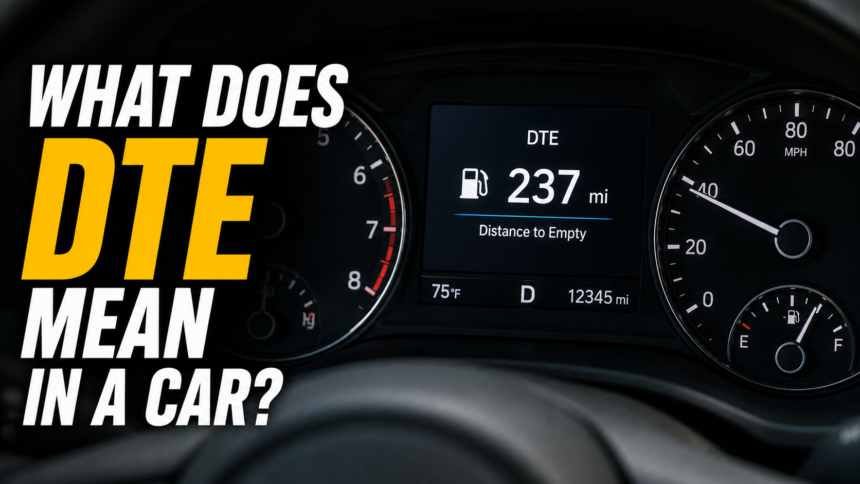
DTE stands for Distance To Empty, and it is the number you see on your dashboard telling you how many miles or kilometers you can still drive before your fuel tank or EV battery runs completely dry.
- What Does DTE Stand For?
- How DTE Works?
- The Basic Calculation Logic
- Real-Time Versus Average Calculation Methods
- Role of the Onboard Computer and Sensors
- Factors That Affect DTE Accuracy
- Driving Style and Speed
- Terrain and Elevation Changes
- Traffic Conditions
- Weather and Climate Control Use
- Vehicle Load and Cargo Weight
- Tire Pressure and Maintenance
- DTE in Electric Vehicles Versus Gas Cars
- DTE Versus Other Dashboard Terms
- Why DTE Numbers Change Suddenly?
- How to Get a More Accurate DTE Reading?
- What to Do When DTE Shows Low or Zero?
- Common Myths About DTE
- Frequently Asked Questions
- Is DTE the same in every car brand?
- Can I reset DTE manually?
- Does DTE work for diesel cars too?
- Why is my DTE different from the actual miles I drove?
- Conclusion
- Related Articles
This figure is not a fixed measurement; it is an estimate that your car’s onboard computer recalculates constantly using your recent driving habits, current fuel or charge level, and even road conditions.
So when someone asks what does DTE mean in a car, the simple answer is that it is your vehicle’s best guess of remaining travel distance, updated in real time so you always have a rough idea of when your next fuel stop or charging session should happen.
What Does DTE Stand For?
DTE is short for Distance To Empty, a dashboard reading almost every modern car, whether petrol, diesel, or electric, displays somewhere on the instrument cluster. It exists purely to give drivers a practical, easy-to-understand number instead of a raw fuel percentage.
The Full Meaning Explained
When your car’s manual or dashboard shows “DTE,” it is simply shortening the phrase Distance To Empty into three letters for quick display space.
This term became standard across manufacturers because drivers needed a number that translates directly into planning, rather than just a fuel bar or percentage that requires mental math.
Where You Can Find DTE on Your Dashboard
Most vehicles display DTE either on the main instrument cluster near the speedometer or within the infotainment touchscreen under a trip or vehicle information menu. In many cars you can cycle through different display modes using a steering wheel button until the DTE reading appears alongside other trip data.
How DTE Works?
Your car calculates DTE by dividing the amount of fuel or battery charge currently available by the rate at which you have been consuming it recently. This means the number is dynamic and shifts based on how you drive, not just how much fuel is physically in the tank.
The Basic Calculation Logic
The onboard computer takes two main inputs: the current fuel or battery level from sensors, and your recent average consumption rate calculated from the last several miles or minutes of driving. Dividing available fuel by this consumption rate produces the estimated distance you see displayed as DTE.
Real-Time Versus Average Calculation Methods
Some vehicles use a short-term rolling average, meaning DTE reacts quickly to sudden changes like highway driving or heavy traffic. Others use a longer averaging window that smooths out fluctuations, giving a steadier but sometimes less immediately accurate number depending on your current driving style.
Role of the Onboard Computer and Sensors
Fuel level sensors, battery management systems, and the vehicle’s ECU work together continuously to feed data into the DTE calculation. This constant flow of sensor information is what allows the number to update automatically without any manual input from the driver.
Factors That Affect DTE Accuracy
DTE is an estimate, not a guarantee, so several real-world factors can push the actual distance you travel higher or lower than what the dashboard predicts. Understanding these factors helps you interpret the number more realistically instead of treating it as an exact countdown.
Driving Style and Speed
Aggressive acceleration, hard braking, and consistently high speeds burn fuel or battery charge faster than smooth, steady driving, which causes the DTE number to drop more quickly than expected. Calm, consistent driving habits typically help the estimate stay closer to what you actually achieve.
Terrain and Elevation Changes
Climbing hills or driving through mountainous routes demands more energy from the engine or motor, reducing your effective range compared to flat terrain. Descending slopes can partially offset this, especially in EVs that recover energy through regenerative braking.
Traffic Conditions
Stop-and-go city traffic generally consumes more fuel per mile than steady highway cruising because of repeated acceleration from a standstill. This is why your DTE might drop faster during a congested commute than during an open highway drive of the same distance.
Weather and Climate Control Use
Cold weather reduces battery efficiency in EVs and increases fuel consumption in traditional engines due to thicker fluids and extra warm-up time. Running the air conditioning or heater also pulls additional energy, which can noticeably shrink your remaining DTE.
Vehicle Load and Cargo Weight
Carrying extra passengers, luggage, or towing equipment adds weight that the engine or motor must work harder to move, directly reducing efficiency. Lighter loads generally allow the vehicle to maintain a DTE reading closer to its rated potential.
Tire Pressure and Maintenance
Underinflated tires increase rolling resistance, forcing the engine to use more fuel to maintain the same speed, which lowers your effective range. Keeping tires properly inflated and the vehicle well maintained helps the DTE estimate stay more reliable over time.
DTE in Electric Vehicles Versus Gas Cars
While the core idea of DTE stays the same across vehicle types, electric cars calculate and display it differently compared to traditional gas or diesel vehicles. EVs tend to show more noticeable swings in the number due to how sensitive battery performance is to outside conditions.
How EV Range Estimates Differ
In an EV, DTE is based on remaining battery percentage rather than a fuel gauge, and battery efficiency can vary more dramatically depending on temperature and driving mode. This is why EV owners often notice their DTE number changing more visibly than in a comparable gas car.
Why EV Estimates Fluctuate More
Battery chemistry is more sensitive to cold temperatures, aggressive driving, and cabin heating or cooling than a combustion engine is to similar factors. As a result, EV DTE readings can jump up or down by a noticeable margin within just a short drive.
The Role of Regenerative Braking
Regenerative braking allows an EV to recover some energy while slowing down, which can actually increase the DTE reading during downhill or braking-heavy driving. This feature is unique to electric and hybrid vehicles and has no direct equivalent in traditional gas-powered cars.
DTE Versus Other Dashboard Terms
Drivers often confuse DTE with other readings on the dashboard, even though each one measures something different. The table below breaks down how DTE compares to commonly seen terms.
| Term | What It Shows | How It Updates |
| DTE (Distance To Empty) | Estimated distance left before fuel or charge runs out | Continuously, based on recent driving |
| Fuel Gauge | Raw fuel level in the tank, usually shown as a bar or percentage | Based only on sensor level, not driving style |
| Trip Meter | Total distance driven since last manual reset | Increases with every mile driven |
| EV Range | Same concept as DTE but specific to battery-powered vehicles | Continuously, factoring in temperature and battery health |
Why DTE Numbers Change Suddenly?
One of the most common points of confusion for drivers is noticing the DTE number jump up or down without an obvious reason. This usually happens because the system is recalculating based on your most recent driving behavior rather than a fixed formula.
Understanding the Recalculation Behavior
If you switch from highway cruising to city traffic, or from smooth driving to sudden acceleration, the system detects this new consumption pattern and adjusts the estimate almost immediately. This is a normal part of how DTE works and not a sign of a malfunction.
How to Get a More Accurate DTE Reading?
While you cannot make DTE perfectly precise, certain habits help keep the estimate closer to what you will actually experience on the road. Consistency in driving behavior is the biggest factor in getting a trustworthy number.
Practical Tips for Reliable Estimates
Driving at a steady speed, avoiding harsh acceleration, keeping tires properly inflated, and minimizing unnecessary weight in the vehicle all contribute to a more dependable DTE figure. Resetting the trip computer after refueling or charging can also help the system build a fresh, accurate consumption average.
What to Do When DTE Shows Low or Zero?
Seeing a low or zero DTE reading can feel alarming, but most vehicles are designed with a safety buffer built into the calculation. Knowing how this buffer works can help you stay calm and plan your next stop confidently.
Understanding the Built-In Safety Margin
Manufacturers typically program a small reserve into the fuel or battery system that is not reflected in the DTE number, meaning you often have a little extra distance even after it hits zero. Many modern cars also automatically suggest nearby gas stations or charging points once the reading drops critically low.
Common Myths About DTE
Because DTE looks like a precise countdown, many drivers assume it is more exact than it actually is. Clearing up these misunderstandings helps set realistic expectations for daily driving.
DTE Is Not Always One Hundred Percent Accurate
The number is an estimate built from recent driving patterns, so it can be optimistic or conservative depending on how your next few miles are actually driven. Treat it as a helpful guide rather than a guaranteed countdown.
Zero DTE Does Not Always Mean an Empty Tank
As mentioned earlier, most vehicles retain a small reserve beyond what the DTE display shows, so reaching zero is a warning to refuel soon rather than an instant sign of running out.
Frequently Asked Questions
Is DTE the same in every car brand?
The core concept is identical, but the exact calculation method and how frequently it updates can vary slightly between manufacturers.
Can I reset DTE manually?
Most vehicles recalculate DTE automatically after refueling or charging, though some allow manual trip computer resets through the dashboard menu.
Does DTE work for diesel cars too?
Yes, diesel vehicles use the same Distance To Empty concept based on remaining fuel and recent consumption patterns.
Why is my DTE different from the actual miles I drove?
Since DTE is an estimate based on past driving behavior, changes in your driving style, terrain, or weather after the reading was calculated can cause the actual distance to differ.
Conclusion
So, what does DTE mean in a car? It simply means Distance To Empty, a real-time estimate of how far you can drive before needing to refuel or recharge.
While it is a genuinely useful tool for daily planning, remember that it reflects an estimate influenced by your driving habits, terrain, and weather rather than an exact countdown. Paying attention to it alongside your fuel gauge gives you the most reliable picture of when it’s time for your next stop.
Related Articles
Does My Car Smell of Petrol? Causes, Risks & Fixes Explained
How Many Engine Mounts Does a Car Have?