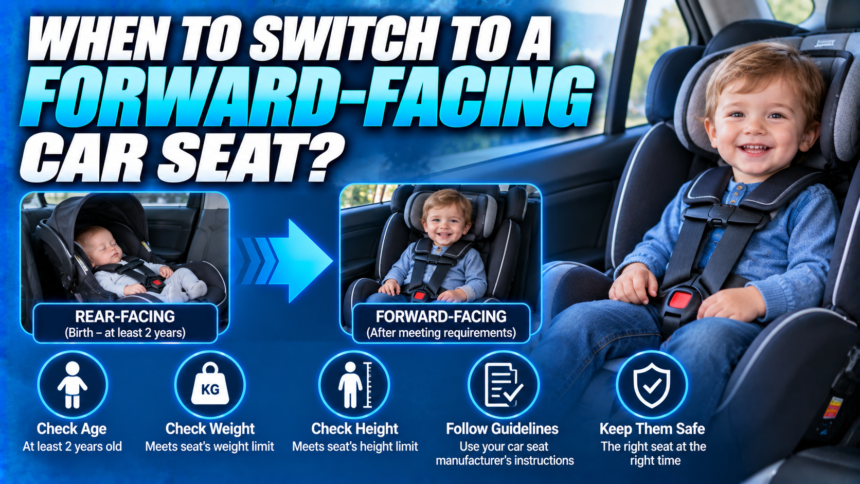
There is no age that answers this question. The switch is triggered by your child outgrowing the rear-facing height or weight limit of your specific car seat, whichever comes first. That is how both NHTSA and the American Academy of Pediatrics frame it, and the wording is deliberate: the seat’s limit is what matters, not the birthday.
- Why the answer is not an age
- How to tell your child has genuinely outgrown rear-facing
- What rear-facing actually does in a crash
- The legs question
- What the law requires versus what is recommended
- Doing the switch properly when it comes
- When rear-facing will not physically fit
- Secondhand seats and expiry dates
- Have the installation checked
- The full sequence, for reference
- Conclusion
- Frequently asked questions
- Related Articles
In practice, with most modern convertible seats, that means well past the second birthday and frequently age three or four. There is also a firm floor underneath it. A child under one year old should always ride rear-facing, without exception.
Why the answer is not an age
NHTSA’s guidance states it plainly: keep your child rear-facing as long as possible, until they reach the top height or weight limit allowed by the car seat’s manufacturer. The AAP’s 2018 policy update moved away from naming a fixed minimum age for exactly this reason. Seats improved, rear-facing weight limits rose to 40 and 50 pounds, and a calendar date had become something parents treated as a target to reach rather than a minimum to exceed.
The underlying principle applies to every stage of car seat use. Each transition, from rear-facing to forward-facing, from harness to booster, from booster to seat belt, trades away a measure of protection in exchange for convenience. The guidance at every stage is therefore the same: delay it as long as the equipment allows.
How to tell your child has genuinely outgrown rear-facing
Three checks, and it is whichever one arrives first. All of them come off the label on the side of your seat and the manual, not from general advice, because limits vary substantially between models.
- Weight: the child exceeds the rear-facing weight limit printed on the seat.
- Height: the child exceeds the rear-facing height limit printed on the seat.
- Head position: on most seats, the top of the child’s head is within one inch of the top of the seat shell. Some manufacturers specify this differently, so check your manual rather than assuming.
Equally important is what does not count. Bent legs, feet braced against the vehicle seat back, a birthday, a child who looks big for their age, and a child who complains are none of them reasons to turn a seat around. If the seat’s limits have not been reached, the child has not outgrown rear-facing.
What rear-facing actually does in a crash
Understanding the mechanism makes the recommendation stop feeling arbitrary. NHTSA describes a rear-facing seat as cradling the child and moving with them in a crash, which reduces stress on the neck and spinal cord. The crash energy is spread across the whole back, with the head, neck and torso supported together and moving as one.
Forward-facing, the harness restrains the torso while the head and limbs continue travelling forward. The load ends up concentrated at the neck. That matters far more for a small child than for an adult, because young children have proportionally large, heavy heads relative to their bodies and cervical spines that are still developing. The forces a young neck can tolerate are correspondingly lower.
One note on the statistics you will encounter. A frequently quoted figure for how much safer rear-facing is traces back to a 2007 US study whose methodology has since been questioned, and NHTSA has itself acknowledged those technical reviews. The direction of the guidance and the physical mechanism behind it are not in dispute, and every major authority still recommends extended rear-facing. But a specific percentage is worth treating with more caution than it usually receives.
The legs question
Bent legs are the single most common reason a child gets turned forward-facing early, and they are not a safety problem.
Children rear-facing sit cross-legged, frog-legged, or with their feet propped against the vehicle seat back, and they are generally comfortable doing so. Adults find the position uncomfortable to look at because adults are not flexible in the same way. The American Academy of Pediatrics addresses this directly, and the position is consistent: leg injuries to rear-facing children are very rare.
Set against that, the injuries extended rear-facing prevents are head, neck and spinal cord injuries. That is not a comparable trade, which is why no safety authority treats leg position as a criterion for turning a seat.
What the law requires versus what is recommended
State laws vary considerably, and many now require rear-facing until at least age two. That is worth knowing, and it is worth checking for your own state.
It is equally worth understanding what a law is. Child restraint laws set a minimum legal standard, and in most states that minimum sits well below what NHTSA and the AAP recommend as best practice. A child can be entirely legal in a forward-facing seat and still be less protected than they would be rear-facing in the same vehicle. Compliance and best practice are different targets, and the law is the lower of the two.
Doing the switch properly when it comes
Turning the seat is not the whole job. The forward-facing configuration has its own requirements, and one of them is skipped constantly.
- Use the top tether. Every forward-facing harnessed seat has one, it attaches to an anchor point in the vehicle, and it significantly limits how far the child’s head travels forward in a crash. It is the most commonly omitted step in the entire process.
- Move the harness straps to the slots at or above the child’s shoulders. This is the opposite of the rear-facing rule, where straps sit at or below shoulder level.
- Position the chest clip at armpit level, not on the abdomen and not at the throat.
- Tighten the harness until you cannot pinch a horizontal fold of webbing at the collarbone.
- Keep the seat in the back. Children should ride in the back seat through age 12.
- Stay in the harnessed forward-facing seat until its own height or weight limit is reached. Moving to a booster early is the same mistake as turning forward early, one stage further along.
When rear-facing will not physically fit
This is the practical constraint that turns more seats around early than any safety reasoning does. A tall driver, a compact car, and a bulky convertible seat can genuinely leave no room behind the front seats.
It is worth knowing that the answer is usually a different seat rather than a different orientation. Rear-facing seats vary enormously in front-to-back footprint, and several models are specifically designed to install upright with a small footprint for exactly this situation. Recline angle also matters: many seats allow a more upright recline as the child gains head control, which recovers several inches. Installing in the centre seating position, or behind the shorter of two front occupants, often solves it outright.
A certified technician can usually find a configuration that works, and swapping to a more compact seat is a smaller compromise than giving up the rear-facing stage early.
Secondhand seats and expiry dates
Two things to check before using any seat you did not buy new. Car seats carry an expiry date, usually stamped into the plastic shell alongside the date of manufacture, because the plastics and webbing degrade with age and temperature cycling. An expired seat is not a seat.
The second is crash history. A seat that has been in a moderate or severe crash should be replaced, and you cannot tell by looking, which is why a seat with unknown history is a seat to decline politely.
Have the installation checked
NHTSA data has found that a majority of forward-facing seats and roughly half of rear-facing seats are installed incorrectly by parents who are trying to get it right. Installation errors are largely invisible once the child is buckled in, which is why they persist.
Certified Child Passenger Safety Technicians inspect and correct installations, usually free of charge, and NHTSA maintains a locator for finding one. Many fire departments and police departments run the same service. It takes around twenty minutes and it is the highest-value thing in this entire article, because a correctly chosen seat installed badly does not deliver the protection it was designed to.
The full sequence, for reference
| Stage | Stay in it until | Then move to |
| Rear-facing seat | The top height or weight limit of that seat | Forward-facing seat with harness and top tether |
| Forward-facing with harness | The top height or weight limit of that seat | Belt-positioning booster seat |
| Booster seat | The adult belt fits correctly, typically around 4 feet 9 inches, usually between ages 8 and 12 | Seat belt alone |
| Every stage | Age 12 | Front seat |
A seat belt fits properly when the lap belt lies snugly across the upper thighs rather than the stomach, and the shoulder belt crosses the shoulder and chest rather than the neck or face.
Conclusion
Do not turn the seat on a birthday. Turn it when your child exceeds the rear-facing height or weight limit printed on that particular seat, whichever comes first, which for most current convertible seats falls somewhere between ages three and four. Children under one always ride rear-facing. Bent legs are not a reason to switch, state law is a floor rather than a goal, and when you do turn the seat, use the top tether and get the installation checked by a certified technician.
This is general safety information. Your car seat’s manual and the labels on the seat itself are the authoritative source for that specific seat, and a certified technician can confirm both the fit and the installation for your child and your vehicle.
Frequently asked questions
Is there a legal age to turn a car seat forward-facing?
It varies by state, and many require rear-facing until at least age two. That is a legal minimum rather than a safety recommendation. NHTSA and the AAP both advise rear-facing until the child reaches the seat’s own height or weight limit.
My child’s legs are bent against the seat. Is that a problem?
No. Children sit comfortably cross-legged or with feet braced, and leg injuries to rear-facing children are very rare. The injuries rear-facing prevents are to the head, neck and spinal cord, which is not a comparable trade.
Can I turn the seat around once my child is two?
Only if they have reached the rear-facing height or weight limit of that seat. Many convertible seats allow rear-facing to 40 or 50 pounds, so most two-year-olds still have room. Check the label on the side of the seat.
What if my child gets carsick or dislikes rear-facing?
Discomfort is not a safety criterion, and children generally adapt. Speak to your pediatrician about motion sickness rather than changing the seat orientation, since the protective difference is greatest in exactly this age range.
Where can I get my car seat installation checked?
Certified Child Passenger Safety Technicians offer free inspections, and NHTSA maintains a locator to find one nearby. Many fire and police departments also provide the service. Installation errors are common and largely invisible once fitted.
Related Articles
Which Nissan Cars Are Discontinued in 2026?
Which One Is the Brake in the Car? Pedal Guide