If your brake pedal feels like a brick and the engine won’t turn over, the most likely cause is a dead or weak 12-volt battery. The two symptoms feel like separate problems, but they usually come from the same source. Your pedal is not locked, and your brakes are not seized. The pedal is simply unassisted, which is how it behaves any time the engine is off.
- Why the pedal goes hard when the car is off
- Try these five things first
- A dead or weak battery (the most likely cause)
- A failed brake light switch
- A steering wheel or shifter lock
- A brake booster or vacuum leak
- Something blocking the pedal
- A blown fuse or a dying key fob battery
- When to stop and call for help?
- Conclusion
- Frequently asked questions
- Related Articles
That is good news. It means the fix is often a jump start, not a tow to a brake shop. Here is what is happening and how to work out which cause you are dealing with.
Why the pedal goes hard when the car is off
Your brakes have a power assist. Most cars use a brake booster, a round metal canister behind the pedal that uses engine vacuum to multiply the force from your foot. When the engine runs, that vacuum is constantly replenished, and the pedal sinks easily under light pressure.
When the engine is off, the booster holds a small reserve of vacuum. That reserve is good for a few pedal presses. After roughly four or five presses, it is gone, and the pedal turns rock hard. You are now pushing the master cylinder directly, with no help at all.
A hard pedal with the engine off is normal. It only points to a fault if the pedal stays hard once the engine is actually running.
This matters because of how modern cars start. In most automatics, and in nearly every push-button car, you must press the brake before the engine will crank. It is a safety interlock that stops the car from starting if someone leans on the button by accident. So if the pedal has gone hard and you cannot push it far enough, the car reads that as “brake not pressed” and refuses to do anything.
The chain looks like this: something stops the engine from starting, you press the brake repeatedly, the vacuum reserve runs out, the pedal goes hard, and now you have two symptoms instead of one.
Try these five things first
Before you assume the worst, run through this. It takes about two minutes and solves the problem more often than not.
- Look at the floor. Check for a floor mat that has slid forward, a water bottle, or a shoe wedged behind the pedal.
- Push much harder than feels normal. Without assist you need real force, and the pedal only has to travel far enough to trip the switch, not all the way to the floor.
- Wiggle the steering wheel. Hold the wheel and rock it firmly left and right while you press the start button or turn the key.
- Watch your dashboard. Press the brake and check whether the lights dim, flicker, or go out. Then have someone stand behind the car and tell you if the brake lights come on.
- Hold the key fob against the start button. On a push-button car this bypasses a dead fob battery. Your owner’s manual will show the exact spot.
If the dash lights up brightly and the brake lights work but nothing happens when you press the button, you are looking at a different problem than someone whose dash goes dark. That difference is the fastest way to narrow this down.
A dead or weak battery (the most likely cause)
This is the answer most of the time. A battery can have enough charge to power your dash, radio, and interior lights while still lacking the current to spin the starter. That is why the car looks alive but does nothing.
The tell-tale signs are a rapid clicking noise when you try to start, dash lights that dim sharply the moment you press the button, or a car that has sat unused for a few weeks. Cold weather makes it worse, because a cold battery delivers less current than a warm one.
A healthy battery reads about 12.4 to 12.7 volts at rest with the engine off. Below roughly 12.2 volts it is significantly discharged. If you have a multimeter, that reading takes ten seconds and tells you nearly everything.
The fix is a jump start or a portable jump pack. One thing worth knowing: a car with a very flat battery sometimes needs a bigger jump than another small car can provide. If jumping from another vehicle fails, that does not rule out the battery. Let the donor car run for several minutes before trying again, or call for roadside help with a proper booster.
Once it starts, drive for at least twenty minutes so the alternator can put charge back in. If the same thing happens the next morning, the battery is likely at the end of its life. Most last three to five years.
A failed brake light switch
The brake light switch is a small plastic sensor mounted on the pedal arm. When you press the pedal, a plunger releases and the switch closes a circuit. It does far more than turn on your brake lights. It tells the computer the brake is pressed, which is exactly the signal your car needs before it will start.
If that switch fails, your pedal might move perfectly well, but the car still behaves as though you never touched it. On a push-button car you may even see a “press brake to start” message on the dash while your foot is firmly on the pedal.
There is one clue that makes this easy to spot. Check whether your brake lights come on. If the pedal moves but the lights stay dark, suspect the switch or its fuse. The other classic sign is a shifter stuck in Park, because the same signal releases the shift interlock.
A switch can also fail stuck in the on position, which keeps your brake lights burning all night and flattens the battery. That gives you a dead battery and a switch fault at the same time, and it explains why some cars do this repeatedly after sitting overnight. AutoZone’s guide to the symptoms of a bad brake light switch covers the other warning signs, including cruise control that will not set.
The switch itself is cheap and, on many cars, twists out by hand in under fifteen minutes. Check the fuse first, since a blown brake light fuse produces identical symptoms for a fraction of the cost.
A steering wheel or shifter lock
If you turned the wheel after switching off, the steering lock can engage against the pressure of the front tyres. On a key-start car the key then will not turn, and it can feel as though everything has seized at once.
Hold the wheel and apply steady pressure to one side, then the other, while turning the key or pressing the start button. Do not force it hard. The lock releases with a small click and the ignition frees up.
A related issue is the shifter. If the car is not fully in Park, or the selector has drifted slightly out of position, the car will not start. Shift firmly into Neutral and try again. Many cars also start in Neutral, which is a useful workaround if Park is the problem.
A brake booster or vacuum leak
This one is less common than the internet suggests, but it is real. If the booster diaphragm is torn, or the vacuum hose feeding it has cracked, the pedal loses its reserve almost immediately rather than after several presses.
There is a simple test. With the engine off, pump the pedal four or five times until it feels firm. Keep your foot on it and start the engine. If the pedal softens and sinks slightly under your foot, the booster is fine. If it stays hard with the engine running, the booster or its vacuum supply has a fault.
Of course, that test needs the engine to run, which is not much help if it will not start at all. That is why booster problems sit lower on the list. A large vacuum leak can also disturb the air-fuel mixture enough to cause a rough or failed start, but you would usually notice hissing under the bonnet and poor running before it got that far.
A failing booster is a safety problem. If your pedal stays hard while driving, stopping distances get much longer. Get it looked at rather than living with it.
Something blocking the pedal
It sounds too simple, but it happens constantly. A rubber floor mat curls up behind the pedal, or an aftermarket mat sits on top of the factory one and bunches forward. The pedal then stops an inch or two early, which is not far enough to trigger the start signal.
Reach down and sweep the whole footwell with your hand. Look for water bottles, phone cables, ice scrapers, and anything that has rolled under the seat. Then pull the mat back and check it clips into its retaining hooks.
A blown fuse or a dying key fob battery
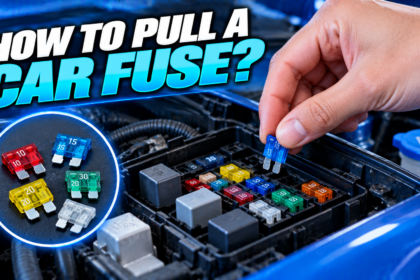
A blown fuse in the brake light or ignition circuit cuts the same signal a failed switch would. Your fuse box diagram is in the owner’s manual or printed on the fuse box lid, and a blown fuse is visible as a broken metal strip inside the plastic housing.
On a push-button car, a flat fob battery is another quick win. Most cars have a backup: hold the fob directly against the start button, or against a marked spot on the steering column, while pressing the brake. The car reads the fob through direct contact instead of radio signal. A replacement cell costs a couple of pounds and takes a minute to fit.
When to stop and call for help?
Call a mechanic or roadside assistance if the car still will not start after a confirmed good jump, if the pedal stays hard once the engine is running, if you smell burning or see brake fluid pooling under the car, or if the engine cranks strongly but never fires. That last one points to fuel, ignition, or an immobiliser fault, none of which have anything to do with your brakes.
Also stop if you find yourself about to force something. A steering lock, an ignition cylinder, and a shifter interlock all break easily, and a snapped key inside the barrel turns a cheap problem into an expensive one.
Conclusion
Start with the battery. A hard pedal alongside a no-start is usually a symptom of low voltage rather than a brake fault, since the pedal always goes firm once the vacuum reserve runs out.
Check for anything blocking the pedal, push harder than feels natural, rock the steering wheel, and see whether your brake lights work. If a good jump start brings it to life and the pedal softens as soon as the engine runs, your brakes were never the problem.
Frequently asked questions
Can a dead battery make the brake pedal hard?
Not directly, but the two go together. A dead battery stops the engine starting, and every attempt you make presses the pedal and uses up the booster’s vacuum reserve. After a few presses the pedal goes hard on its own.
How do I start my car if the brake pedal won’t go down?
Push much harder than usual, since the pedal only needs to travel far enough to trip the switch. Also clear the footwell of mats or objects, and try shifting firmly into Neutral before starting.
Why does my car say press brake to start when I already am?
The computer is not receiving the brake signal. That usually means a failed brake light switch, a blown brake light fuse, or a pedal that is not travelling far enough. Check whether your brake lights come on.
Is it safe to drive with a stiff brake pedal?
No. If the pedal stays hard while the engine is running, your power assist has failed and stopping distances get much longer. Have the booster and vacuum hose checked before driving.
How much does it cost to fix a brake light switch?
The part itself is inexpensive, often under twenty pounds or dollars, and on many cars it twists out by hand in fifteen minutes. Labour at a garage is usually under an hour.
Related Articles
What Is the Best Battery Brand for a Car? An Honest Guide
Are Automatic Car Washes Bad for Your Car?