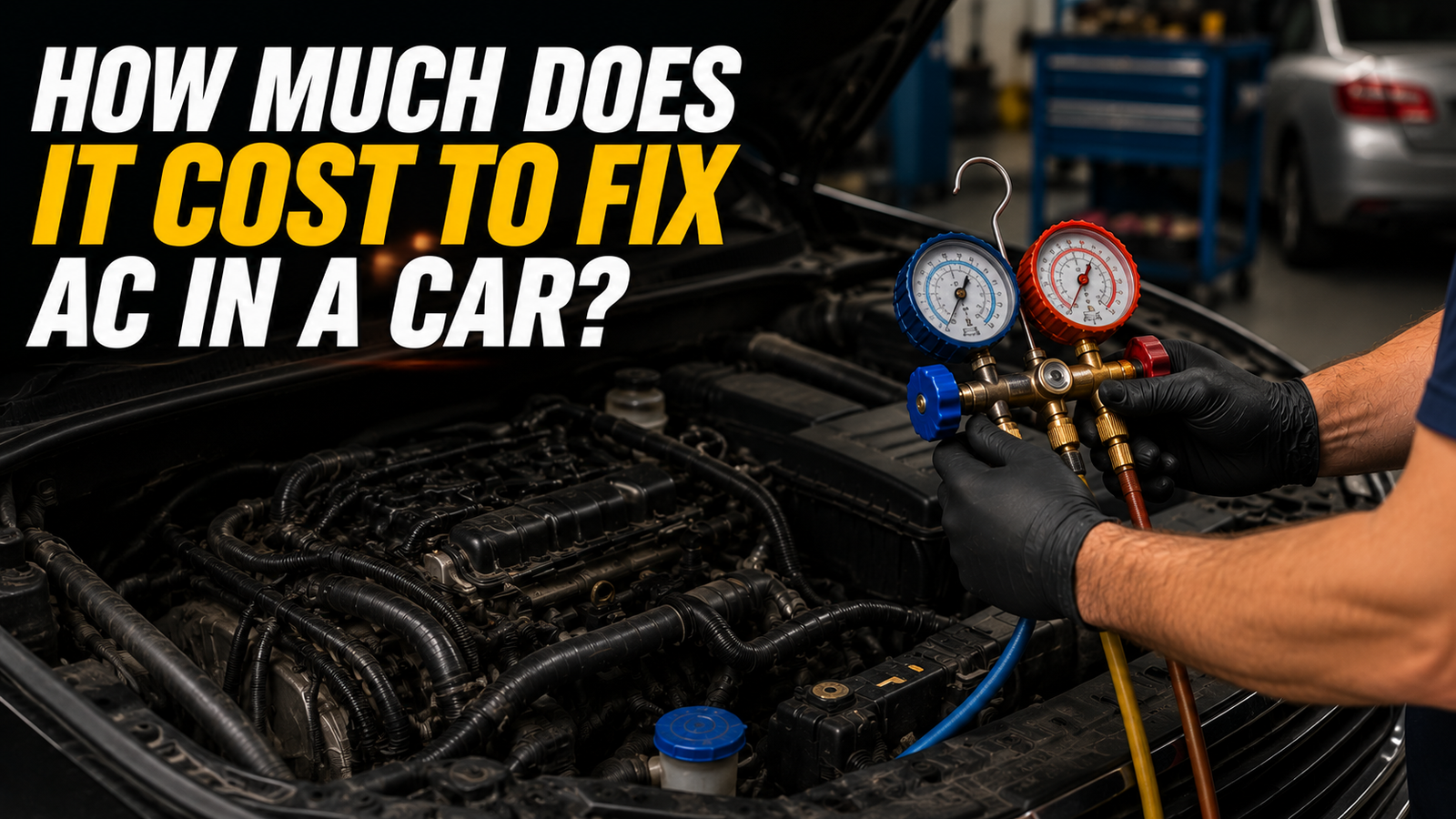
Fixing a car’s AC usually costs between $150 and $300 for a simple refrigerant recharge, a few hundred dollars for a leak repair, and $800 to $2,000 for a failed compressor. The price swings so widely because it depends entirely on which part has failed. A quick top-up is cheap; replacing a major component behind the dashboard is not.
Before you assume the worst, it helps to know the typical cost of each repair, what makes the price rise or fall, and how to avoid paying twice for the same problem. Here is a clear breakdown for 2026.
Cost by type of repair
AC problems range from a simple recharge to a full component replacement, and the cost follows the job. Here are the common repairs and what to expect to pay:
| Repair | Typical cost | How common |
| Diagnostic / leak detection | $75 to $150 | Usually first step |
| Refrigerant recharge | $150 to $300 | Very common |
| Small leak or O-ring / hose repair | $150 to $600 | Common |
| Condenser replacement | $400 to $900 | Fairly common (road debris) |
| Evaporator replacement | $700 to $1,500+ | Less common, labor-heavy |
| Compressor replacement | $800 to $2,000 | The priciest common repair |
These are typical ranges at an independent shop, and your exact quote will depend on your car and where you live. As ConsumerAffairs reports, the compressor is the most expensive part, often more than $1,000, while a recharge is the most affordable and most common service.
The recharge: cheapest but often not the real fix
A refrigerant recharge is the cheapest AC service, and it is what many people hope they need. It refills the refrigerant that makes the cold air. But here is the catch that saves or costs you money.
The AC system is sealed, so refrigerant does not get used up over time. If it is low, it leaked out. That means a recharge alone is often a temporary fix: the AC blows cold for a few days or weeks, then goes warm again as the refrigerant leaks back out. To fix it for good, the leak has to be found and repaired first.
Watch out for any shop that recharges the system without checking for a leak. It is a setup to make you pay twice, once for the recharge now and again when it leaks out. Paying for a proper leak diagnosis first is cheaper in the long run.
This is why a leak repair, anywhere from about $150 for a simple O-ring to $600 for hoses or lines, is money better spent than repeated recharges.
Why a compressor is the expensive one?
The compressor is the heart of the AC system. It pressurizes the refrigerant and circulates it, and without it working, no amount of refrigerant will cool the car. It is also the priciest common repair, typically $800 to $2,000.
Part of that cost is the part itself, and part is labor, since the compressor can be awkward to reach. Warning signs of compressor trouble include a grinding noise when the AC is on, warm air that returns soon after a recharge, or oil residue around the compressor. Because it is such a big-ticket item, it is worth getting a proper diagnosis before agreeing to replace it, so you are not paying for a compressor when a cheaper part was the real cause.
What makes the price go up or down?
Two cars with the same fault can get very different quotes. These are the main factors that move the price:
- Which part failed. This is the biggest factor by far. A recharge is hundreds of times cheaper than an evaporator job. Accurate diagnosis is the number one way to control cost.
- Component accessibility. Some parts are easy to reach; others need heavy disassembly. The evaporator sits behind the dashboard, so its labor is high even though the part itself is not huge.
- Vehicle type. Compact cars are cheapest. Trucks and larger vehicles have bigger systems and need more refrigerant. Luxury and European models cost significantly more in parts and labor.
- Shop type. Dealerships charge the most, often 30 to 50 percent more than independents. General independent shops and dedicated AC specialists usually offer better value.
- Refrigerant type. Newer cars use a pricier refrigerant, which alone can add $100 to $200 (see below).
The refrigerant factor (R-134a vs R-1234yf)
One cost surprise catches owners of newer cars off guard: the type of refrigerant. Older vehicles use R-134a, which is relatively cheap. Cars from around 2017 onward use a newer, more environmentally friendly refrigerant called R-1234yf, which costs roughly two to three times as much per pound.
That difference alone can add $100 to $200 to a repair, even for a straightforward recharge. It is not something you can avoid, since your car requires the type it was built for, but it explains why the same job can cost more on a newer car than an older one. If your car is a recent model, factor this into your budget.
Should you DIY or use a shop?
Some minor AC tasks are DIY-friendly, but most are not, and the risks are real. A recharge kit from a parts store costs around $30 to $60, and replacing a blown AC fuse can cost under $20. Those can be reasonable for the simplest cases.
Beyond that, professional service is strongly recommended. Handling refrigerant requires special tools and, in many places, certification, because releasing it is both illegal and harmful. DIY mistakes can be expensive too: overcharging the system can damage the compressor, and a recharge that ignores a leak just wastes money and refrigerant. C
ompressor, condenser, and evaporator work need specialized tools and expertise, and professional repairs usually come with a warranty, often 12 months on parts and labor, which is worth a lot on a major job.
How to avoid overpaying?
AC repair is a place where informed owners save real money. A few habits keep the bill fair:
- Pay for a diagnosis first. A diagnostic fee of $75 to $150 pinpoints the exact fault and prevents paying for parts you do not need. Guessing is what gets expensive.
- Fix the leak, do not just recharge. Repeated recharges cost more over time than one proper repair. Insist the leak be found before refilling.
- Get more than one estimate. Prices for the same job can vary by hundreds of dollars. Independent shops and AC specialists often beat dealer rates.
- Ask why each part is being replaced. A good shop can explain the reason for every line item. Be cautious of a big compressor quote with no clear diagnosis behind it.
- Check your warranty. If your car is still under the factory bumper-to-bumper warranty, an AC failure from a defect may be covered.
Conclusion
The cost to fix a car’s AC depends entirely on the part: about $150 to $300 for a recharge, a few hundred for a leak, and $800 to $2,000 for a compressor, with newer cars costing more thanks to pricier refrigerant.
The smartest move is to pay for a proper diagnosis first and fix any leak rather than just recharging, or you will pay twice. Get more than one estimate, favor an independent or AC specialist over a dealer, and ask why each part is being replaced. That is how you stay cool without overpaying.
Frequently asked questions
How much does an AC recharge cost? Usually about $150 to $300, though some shops charge $400 or more when it includes inspection and leak detection. It is the cheapest AC service, but only lasts if any leak is fixed.
Why is replacing an AC compressor so expensive? The compressor is a major part and can be labor-intensive to reach, so replacement typically runs $800 to $2,000, more on luxury vehicles. Get a diagnosis first before agreeing to replace it.
Is it cheaper to recharge or repair the AC? A recharge is cheaper upfront, but if there is a leak it is only temporary. Fixing the leak costs more now but saves money versus paying for repeated recharges.
Why does my newer car’s AC repair cost more? Cars from about 2017 on use R-1234yf refrigerant, which costs two to three times more than the older type, adding $100 to $200. Modern dash layouts can also raise labor.
Does car insurance cover AC repair? Usually not, since AC failure is considered normal wear. But if the AC is damaged in a covered accident or by vandalism, it may be covered under collision or comprehensive, minus your deductible.
Related Articles
Why Does My Car Smell Like Burning Oil?
Can You Put Gas in a Running Car?