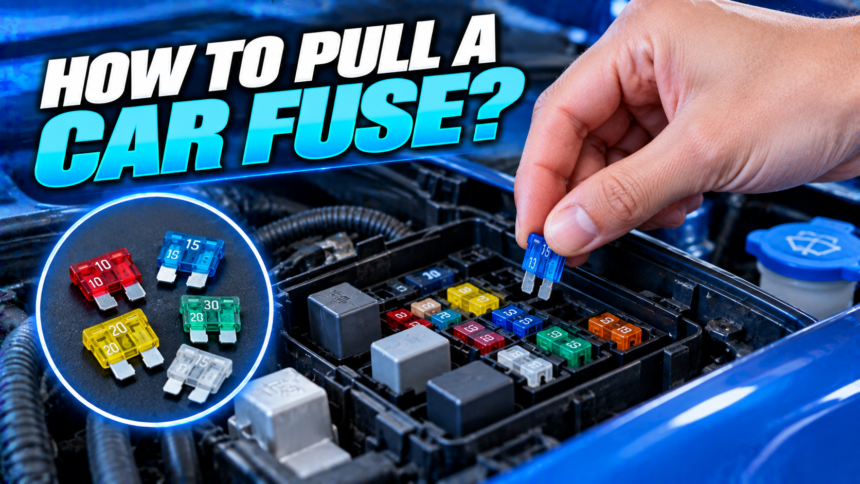
Turn the ignition off, open the fuse box, find the right slot on the lid diagram, grip the fuse with a fuse puller, and draw it straight out. No rocking, no levering, no wiggling.
- Before you touch anything
- Finding the fuse box
- Reading the diagram and picking the right slot
- Pulling the fuse, step by step
- Fuse types and why the pull differs
- How to tell whether the fuse is blown
- Fitting the replacement
- If the new fuse blows straight away
- Never fit a bigger fuse
- Conclusion
- Frequently asked questions
- Related Articles
That is the whole physical job, and it takes about ten seconds. The parts worth knowing are how to find the right fuse in the first place, how to tell whether it has actually blown, and what to do if the new one blows the moment you fit it.
Before you touch anything
Switch the ignition off and take the key out. On a push-button car, make sure it is fully shut down rather than in accessory mode.
For an ordinary blade fuse, that is enough. You do not need to disconnect the battery, and doing so on a modern car means losing radio presets and sometimes forcing the engine management to relearn its idle settings.
There is one exception. Large bolt-down or cartridge fuses in the engine bay sit on high-current circuits, often straight off the battery. If you are removing one of those, disconnect the negative battery terminal first.
Keep metal tools away from the fuse box while you work. A screwdriver bridging two terminals will make sparks and can blow more fuses than you started with.
Finding the fuse box
Most cars have at least two, and some have three.
- Under the dashboard. Usually on the driver’s side, behind a pull-off panel by your knees or beside the door opening. This one handles interior circuits: lights, radio, windows, wipers.
- In the engine bay. A black plastic box with a clip-on lid, normally near the battery. This holds the higher-current fuses and relays for things like the cooling fan, fuel pump, and headlights.
- In the boot or under a seat. Common on larger cars and on models where the battery lives in the boot.
If you cannot find it, the owner’s manual gives the location and the diagram. If the manual is missing, the manufacturer’s website usually carries a PDF copy for your model and year.
Many cars keep a small plastic fuse puller clipped inside one of the boxes, along with a few spare fuses. It is worth checking for before you go looking for tools.
Reading the diagram and picking the right slot
The lid of the fuse box normally carries a printed map showing which slot does what. Some are printed on a label inside the panel instead, and some appear only in the manual.
Two things trip people up here. First, the diagram is usually oriented as though you are looking at the box from a particular angle, which may not be the angle you are actually at. Check a landmark, such as an empty slot or the largest fuse, to confirm which way round you are reading it.
Second, the labels are abbreviated and not always obvious. Common ones include IGN for ignition, ACC for accessory, HTR for heater, WPR for wiper, and RR for rear. If a label makes no sense, the manual expands it.
Photograph the fuse box with your phone before you remove anything. If a fuse drops into the dashboard or you lose track of which slot was which, that picture is the fastest way back.
Pulling the fuse, step by step
- Switch the ignition off and remove the key.
- Open the fuse box. Dashboard panels usually unclip by hand, and engine bay lids have clips at the sides. Neither should need force.
- Find your fuse on the diagram and count across to it physically. Slots are close together and it is easy to be one out.
- Grip the fuse with the puller across its flat faces, not its narrow edges. If you are using needle-nose pliers instead, hold the plastic body and not the metal blades.
- Pull straight up, in line with the fuse. Steady pressure rather than a jerk. If it is stiff, keep pulling straight rather than levering it sideways.
- Look at the fuse in good light to see whether the metal strip inside is broken.
Pulling straight matters more than it sounds. Rocking a fuse from side to side splays the brass contacts inside the socket, and a splayed socket grips the next fuse loosely. That causes heat, intermittent faults, and a circuit that fails again later for no obvious reason.
If a fuse is genuinely stuck and you have no puller, the corner of a folded piece of card can improve your grip on the plastic. Avoid using a screwdriver as a lever.
Fuse types and why the pull differs
Not all car fuses look the same, and the smaller modern ones are noticeably harder to grip.
| Fuse type | Colour code | How to pull it |
| Micro2 and micro3 | Standard | Very small and tight. A proper puller helps most here |
| Low-profile mini | Standard | Sits almost flush, so grip the sides rather than the top |
| Mini blade | Standard | The most common modern size. Straight pull with a puller |
| Regular (ATO/ATC) | Standard | Older and larger. Often loose enough for fingers |
| Maxi blade | Standard | High-current circuits. Firm straight pull, sometimes stiff |
| Cartridge and bolt-down | Varies | Held by screws or bolts. Disconnect the battery first |
The colour tells you the rating: they follow a standard scheme, so a red fuse is 10 amp, a blue one 15, a yellow one 20, and so on across the sizes. The number is also printed on the top. Never rely on colour alone from memory, because faded fuses are easy to misread. Read the number.
How to tell whether the fuse is blown
Hold the fuse up to a light and look through the clear plastic window on top. A good fuse has an unbroken metal strip running between the two blades. A blown one has a visible gap in that strip, and often a scorched or cloudy patch inside the plastic.
Some failures are harder to see. A hairline break can look intact at a glance, and a fuse that has failed under heat may look fine while no longer conducting. If you are unsure, test it with a multimeter set to continuity: touch a probe to each blade, and a good fuse beeps while a blown one does not.
There is a quicker way that avoids removing anything at all. Most fuse boxes leave the two blade tips exposed at the top of each fuse. With the circuit switched on, touch a test light or multimeter probe to each tip in turn. Power on both sides means the fuse is fine; power on one side only means it has blown. AutoZone’s guide to replacing a car fuse covers the bolt-down types in more detail if that is what you are facing.
Fitting the replacement
The replacement must match the original rating exactly. A 10 amp fuse is replaced by a 10 amp fuse, and the physical size and type must match too, since a mini fuse will not sit properly in a regular socket.
Line the blades up with the slot and push straight down until it seats. You should feel it stop firmly. A fuse that sits proud or feels loose is not making full contact, which creates heat at the terminals.
Then switch on and test the circuit that failed. If it works, put the lid back on properly, since these covers keep moisture and dirt out and the engine bay one matters more than it looks.
It is worth carrying a small assortment of spare fuses in the glovebox. They cost very little and turn a roadside problem into a two-minute fix.
If the new fuse blows straight away
A fuse is a deliberate weak point. It did not fail by accident, it failed doing its job, and if a fresh one goes immediately then something on that circuit is still drawing far too much current.
Work through it methodically.
- Note when it blows. Immediately on fitting suggests a hard short to earth. Only when you operate a particular switch narrows it to that component.
- Unplug accessories on that circuit. Phone chargers, dashcams, and aftermarket stereos are frequent offenders, especially if wired in with scotch locks.
- Look for chafed wiring. Check anywhere a loom passes through a bulkhead, near a hinge, or under a seat rail. Bare copper touching bodywork is a classic cause.
- Consider water. A soaked footwell or a leaking boot seal can short a circuit and will keep doing so until it dries out and the corrosion is cleaned.
- Stop after two. If you have fitted two fuses and both blew, stop replacing them and have the circuit diagnosed. Repeatedly feeding a short does no good and heats the wiring each time.
Never fit a bigger fuse
This is the one thing on this page that can genuinely set a car on fire, and it is tempting precisely because it appears to work.
A fuse is rated below the safe capacity of the wire behind it. That is the entire design: when something goes wrong, the fuse is meant to be the part that fails, because it is cheap, accessible, and contained. Fit a 30 amp fuse where a 10 belongs and the fuse stops being the weak point. The wiring becomes the weak point instead, and wiring fails by melting its insulation inside a loom you cannot see, behind the dashboard.
Wrapping foil around a fuse, or pushing in a nail or a strip of wire, does the same thing more completely. Nothing about a working circuit is worth that risk.
The same logic applies downward. A fuse rated too low will blow under normal load, which is annoying but safe. If a circuit keeps blowing correctly rated fuses, the answer is to find the fault, not to move the rating.
Conclusion
Ignition off, check the diagram, grip the fuse across its flat faces, and pull straight out. Look through the window for a broken strip, and replace it with the identical rating and type. If the new one blows too, treat that as information rather than bad luck and trace the circuit, because the fuse is doing exactly what it was designed to do. Above all, never fit a higher rating to make a problem go away.
Frequently asked questions
Do I need to disconnect the battery to pull a car fuse?
Not for ordinary blade fuses. Switching the ignition off is enough. Disconnect the negative terminal first only for large bolt-down or cartridge fuses, which sit on high-current circuits near the battery.
How do I know which fuse to pull?
Check the diagram on the fuse box lid or in the owner’s manual, then count across physically to confirm the slot. Photograph the box first so you have a reference if anything gets moved.
Can I pull a car fuse with my fingers?
Sometimes, on older full-size fuses. Modern mini and micro fuses sit too tight and too flush. A plastic fuse puller costs very little and avoids splaying the socket contacts.
What happens if I use a higher amp fuse?
The fuse stops protecting the wiring. Excess current then flows until something else fails, and that something is usually wiring inside a loom, which can melt its insulation and start a fire.
Why does my car fuse keep blowing?
Something on that circuit is drawing too much current, commonly a chafed wire touching bodywork, a failing motor or component, water ingress, or a badly wired accessory. Stop after the second fuse and trace the fault.
Related Articles
How to Pull a Vacuum on a Car AC System: Step by Step
How to Put Brake Fluid in a Car: Do This First