If you’ve just watched your odometer roll past 200,000 miles, or you’re eyeing a used car with that number on the dashboard, you’ve probably asked yourself the same question thousands of other drivers ask every day: is 200,000 miles on a car bad?
- Is 200,000 Miles Actually a Lot?
- Mileage vs. Age vs. Maintenance — Which Matters Most?
- What Typically Happens to a Car at 200,000 Miles
- Which Cars Handle 200,000+ Miles Best
- Signs Your High-Mileage Car Is Still Healthy
- Red Flags That Signal Trouble at High Mileage
- Should You Buy a Car with 200,000 Miles?
- Should You Keep Driving Your Car Past 200,000 Miles?
- Tips to Maximize a Car’s Lifespan
- Conclusion
- FAQs
- Related Articles
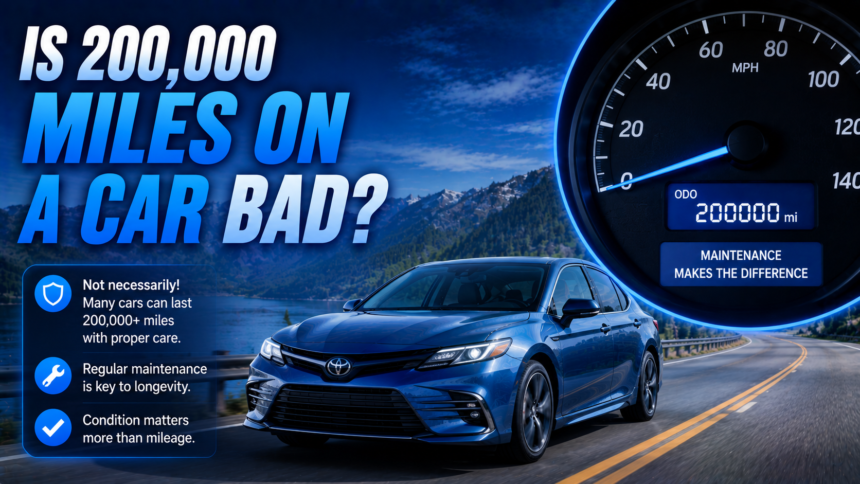
The short answer is: not necessarily. A high odometer reading sounds alarming, but mileage by itself doesn’t tell the whole story of a vehicle’s health. A car that’s been serviced on schedule, driven gently, and kept rust-free can easily outlast a car with half the mileage that’s been neglected. On the other hand, a poorly maintained vehicle can start falling apart well before it even reaches 100,000 miles.
In this guide, we’ll break down what 200,000 miles really means for a car, which factors matter more than the number on the odometer, which brands tend to go the distance, and how to tell whether a high-mileage car is a smart purchase or a money pit waiting to happen.
Is 200,000 Miles Actually a Lot?
To put things in perspective, the average driver in the U.S. covers somewhere between 12,000 and 15,000 miles a year. Do the math, and 200,000 miles represents roughly 13 to 16 years of typical driving. That’s a long time for hundreds of moving parts to work together without something eventually needing attention.
However, “a lot of miles” doesn’t automatically mean “a lot of problems.” Cars today are built very differently from cars made in the 1980s and 90s. Improvements in engine metallurgy, synthetic oils, computer-controlled fuel injection, and rust-proofing have pushed the realistic lifespan of a well-built modern car from around 100,000–150,000 miles (the old benchmark) up to 200,000–300,000 miles or more.
So while 200,000 miles used to be considered “near death” for a vehicle, today it’s often just middle age — especially for cars known for long-term durability.
Mileage vs. Age vs. Maintenance — Which Matters Most?
Here’s a truth that surprises a lot of car shoppers: maintenance history matters more than the odometer number.
Think about it this way. A car with 200,000 highway miles, regular oil changes, and a single long-term owner is often in far better shape mechanically than a car with only 80,000 miles that’s spent its life doing short, stop-and-go city trips with skipped oil changes. Short trips are actually harder on an engine than steady highway cruising because the engine rarely reaches full operating temperature, which allows moisture and unburned fuel to contaminate the oil.
A few factors that influence how a car ages, aside from raw mileage:
- Driving style — aggressive acceleration and hard braking wear components faster than smooth, steady driving.
- Climate — cars in regions with road salt or extreme heat tend to suffer more rust and rubber degradation.
- Terrain — frequent hill driving or towing puts extra strain on the engine and transmission.
- Number of owners — a single careful owner’s car is often better maintained than one passed through several hands.
- Storage conditions — a garage-kept car ages more slowly than one left outdoors year-round.
In short, a well cared-for 200,000-mile car can be a better buy than a neglected 100,000-mile car. The number on the odometer is just one piece of the puzzle.
What Typically Happens to a Car at 200,000 Miles
That doesn’t mean high mileage has zero effect — it does. By 200,000 miles, certain parts of a car are statistically more likely to need attention. Here’s a general breakdown of what tends to wear out around this mark:
| Component | What Tends to Happen at High Mileage |
|---|---|
| Engine | Piston rings and seals wear, leading to minor oil consumption; timing components may need replacement |
| Transmission | Fluid breakdown can cause rougher or delayed shifting if not serviced |
| Suspension | Shocks, struts, and bushings often soften or wear out |
| Steering | Tie rods, ball joints, and power steering components may loosen |
| Electrical system | Sensors, wiring, and connectors can become less reliable |
| Interior/Exterior | Seats, dashboard plastics, paint, and trim show visible wear |
None of this means a car is doomed — most of these are normal wear items that can be replaced individually, often for a fraction of the cost of a new car payment.
Which Cars Handle 200,000+ Miles Best
Not all vehicles age the same way. Some manufacturers have built reputations specifically around long-term reliability, while others are known to struggle once the odometer climbs.
Brands known for going the distance:
- Toyota (especially the Camry, Corolla, and Land Cruiser)
- Honda (Civic, Accord, CR-V)
- Lexus
- Subaru (with regular maintenance, especially head gasket care)
- Mazda
Vehicles that often need more attention at high mileage:
- Many European luxury brands (due to costly, complex components)
- Certain American models with historically weaker transmissions
- Vehicles with turbocharged engines that weren’t maintained with frequent oil changes
Engine type also plays a role. Naturally aspirated engines are generally simpler and often more forgiving of high mileage than turbocharged engines, which run hotter and place more stress on internal components. Diesel engines, when properly maintained, are often built for exceptionally long lifespans compared to gas engines.
Signs Your High-Mileage Car Is Still Healthy
If you already own a car nearing or past 200,000 miles, don’t panic. Look for these positive signs that your vehicle still has plenty of life left:
- A consistent service history with oil changes roughly every 5,000–7,500 miles
- No major warning lights currently illuminated
- No visible fluid leaks under the car
- Smooth, hesitation-free shifting
- No unusual knocking, grinding, or rattling sounds
- A rust-free frame and undercarriage
- Tires wearing evenly, suggesting healthy suspension and alignment
If most of these apply to your car, it’s likely in good enough shape to keep going for a long time yet.
Red Flags That Signal Trouble at High Mileage
On the flip side, certain symptoms suggest a high-mileage car may be heading toward expensive repairs:
- Blue or white smoke from the exhaust, which can point to burning oil or coolant
- Frequent check engine lights, especially if they keep returning after being cleared
- Transmission slipping, jerking, or delayed engagement
- Noticeable oil consumption between changes
- Rust on structural or suspension components, not just surface rust on the body
- Unusual vibrations while driving or braking
If you’re noticing several of these at once, it may be time to have a trusted mechanic take a closer look before the issues compound.
Should You Buy a Car with 200,000 Miles?
Buying a car with 200,000 miles already on it can be a smart financial move — or a costly mistake — depending on the specific vehicle.
Potential advantages:
- Significantly lower purchase price than a newer model
- Most of the steep depreciation has already happened
- Can be a practical option for a budget-conscious buyer or a temporary vehicle
Potential downsides:
- Less remaining lifespan before major repairs are likely
- Higher chance of needing multiple repairs in a short time span
- Harder to get favorable financing or warranty coverage
Before buying any high-mileage vehicle, it’s worth asking the seller a few key questions: Do they have maintenance records? Has the timing belt/chain ever been replaced? Any major accidents or transmission work? Has the car ever overheated?
Most importantly, always arrange a pre-purchase inspection (PPI) from an independent mechanic. This single step can save buyers from inheriting someone else’s expensive problem.
Should You Keep Driving Your Car Past 200,000 Miles?
If you already own the car, the decision often comes down to simple math: compare the cost of ongoing repairs against the cost of a car payment on something newer.
As a general rule of thumb, if a single repair costs less than what you’d spend in a few months of car payments, and the car is otherwise reliable, it’s usually worth fixing rather than replacing. Safety should also factor in — worn brakes, bald tires, or unreliable steering components are not areas to compromise on, regardless of the car’s age.
To extend a high-mileage car’s life further:
- Stay strict about oil change intervals
- Replace worn suspension and steering parts promptly
- Keep an eye (and ear) out for early warning signs of trouble
- Address small issues before they escalate into bigger, costlier failures
Tips to Maximize a Car’s Lifespan
Whether your car has 50,000 miles or 250,000 miles, these habits help maximize how long it lasts:
- Change the oil on schedule — this is the single most important habit for engine longevity.
- Replace the timing belt or chain at the manufacturer’s recommended interval, since a snapped belt can destroy an engine.
- Rotate and align tires regularly to reduce uneven wear and strain on the suspension.
- Flush and replace fluids (coolant, transmission, brake fluid) as recommended, not just when something goes wrong.
- Fix small issues immediately — a minor leak or odd noise is often cheaper to fix early than to ignore.
- Wash and rustproof regularly, especially in areas with road salt or high humidity.
Conclusion
So, is 200,000 miles on a car bad? Not on its own. Mileage is just one number among many that determine whether a vehicle still has useful life left in it. A well-maintained car with 200,000 miles can be more dependable than a neglected car with far fewer miles on the clock. What matters most is the maintenance history, how the car was driven, and whether any warning signs are currently present.
If you’re buying a high-mileage vehicle, get a full maintenance history and a professional inspection before committing. If you already own one, focus on the habits that extend its life — consistent maintenance, prompt repairs, and paying attention to how the car feels and sounds day to day.
FAQs
Is 200,000 miles high for a used car? It’s considered high mileage, but not unusual for well-built, well-maintained vehicles, especially those from brands known for reliability.
What car brands last the longest? Toyota, Honda, Lexus, Subaru, and Mazda are frequently cited as brands whose vehicles commonly surpass 200,000 miles with proper care.
How many miles is too many to buy a used car? There’s no fixed cutoff, but many buyers get cautious above 150,000–200,000 miles unless there’s strong documentation of consistent maintenance and a clean inspection.
Can a car last 300,000 miles? Yes. With disciplined maintenance, gentle driving habits, and timely repairs, many reliable models can reach 300,000 miles or more.
Related Articles
How Many Miles Does a Tesla Get? Full 2026 Range Guide by Model
How Many Miles Does a Honda Civic Last? Real Lifespan Guide
How to Clean Cloth Seats in the Car: A Complete Step-by-Step Guide
What SUV Has LY7 Engine? Complete Guide, Specs & Buying Tips