If you’ve ever been blinded by an oncoming car at night, or wondered whether your headlights are actually as bright as they should be, you’ve probably typed some version of “how many lumens is a car headlight” into Google. It’s a fair question, and the honest answer is: it depends on what kind of bulb is in your headlight housing. A basic halogen low beam and a modern LED low beam can differ by a factor of five or more, even though they’re doing the same job.
- What Is a Lumen, and Why Does It Matter for Headlights?
- How Many Lumens Is a Car Headlight, By Bulb Type?
- What’s the Actual U.S. Legal Standard? (Most Guides Get This Wrong)
- How Many Lumens Do You Actually Need?
- How to Check Your Car’s Factory Headlight Lumens
- Signs Your Headlights Aren’t Putting Out Enough Light
- A Practical Buying Checklist for Headlight Upgrades
- Frequently Asked Questions
- Conclusion
- Related Articles
This guide breaks down real-world lumen ranges for every headlight type on the road today, explains what U.S. law actually regulates (hint: it isn’t lumens), and gives you a practical framework for choosing or upgrading your headlights without turning into “that car” that blinds everyone else on the highway.
What Is a Lumen, and Why Does It Matter for Headlights?
A lumen is a unit of measurement for the total visible light a source produces. Think of it as the raw “amount” of light coming off the bulb in every direction, before that light gets shaped, focused, or aimed by the headlight housing.
Here’s the part most articles skip: lumens describe how much light a bulb makes, not how much of that light actually lands on the road in front of you. Two headlights rated at 6,000 lumens can perform completely differently depending on the reflector design, lens clarity, and beam pattern of the housing they’re installed in. That’s why lumens are a useful starting point for comparing bulbs, but they’re not the whole story on headlight performance.
How Many Lumens Is a Car Headlight, By Bulb Type?
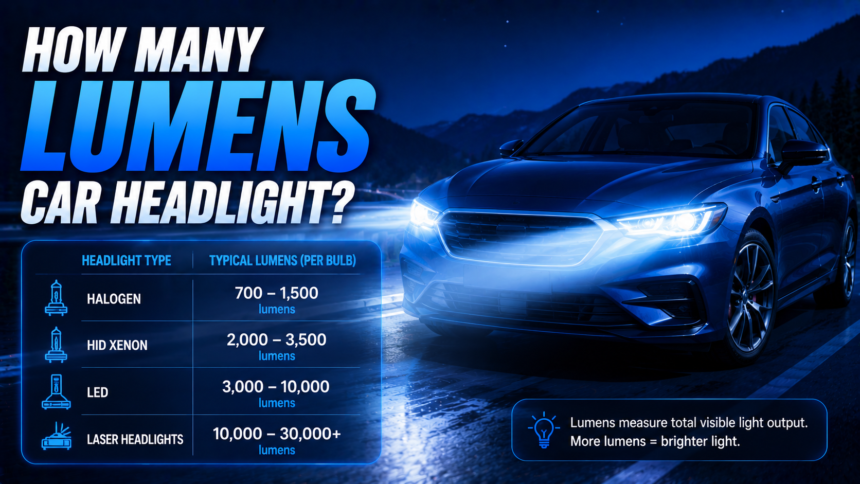
The number of lumens a car headlight produces depends almost entirely on the bulb technology. Here’s how the major types compare, based on typical manufacturer specifications and industry testing data:
| Bulb Type | Low Beam (per bulb) | High Beam (per bulb) | Typical Lifespan |
|---|---|---|---|
| Halogen | 700–1,200 lumens | 1,200–1,500 lumens | 450–1,000 hours |
| HID/Xenon | 3,000–3,500 lumens | Up to 4,000 lumens | 2,000–3,000 hours |
| LED | 3,000–6,000 lumens | 4,000–8,000 lumens | 20,000–50,000 hours |
| Laser | 8,000–10,000+ lumens | Up to 12,000 lumens | 10,000+ hours |
Halogen Headlights
Halogen bulbs are still the most common headlight technology on U.S. roads, largely because they’re cheap and simple to manufacture. A halogen low beam typically produces around 700 to 1,200 lumens, while the high beam filament in the same bulb can push out 1,200 to 1,500 lumens. They run hot, burn out faster than other technologies, and cast a warm yellowish light around 3,000K in color temperature.
HID (Xenon) Headlights
High-intensity discharge headlights work by passing an electric arc through xenon gas rather than heating a filament. This produces roughly 3,000 to 3,500 lumens per bulb, more than double a halogen bulb, with a crisp white-blue light. HID systems require a ballast to ignite the arc, which means there’s a brief warm-up period before they hit full brightness. They’re increasingly being phased out in favor of LED on new vehicles.
LED Headlights
LED is now the dominant technology on new vehicles and the most popular aftermarket upgrade. LED headlight bulbs typically range from 3,000 to 6,000 lumens on low beam and 4,000 to 8,000 lumens on high beam, though some aftermarket kits marketed for off-road or racing use claim considerably more. LEDs reach full brightness instantly, use less power than halogen, and can last tens of thousands of hours if properly cooled.
Laser Headlights
Laser headlights are the newest and least common technology, currently found mostly on high-end luxury vehicles like certain BMW and Audi models. A laser diode excites a phosphor material to produce an extremely bright, tightly focused beam, in the 8,000 to 10,000+ lumen range and beyond for high beam. They offer exceptional range, but the technology remains expensive and isn’t widely available in the aftermarket yet.
What’s the Actual U.S. Legal Standard? (Most Guides Get This Wrong)
Here’s something almost every headlight article gets slightly wrong: there is no federal “lumen limit” for headlights in the United States. Lumens measure total light output, but Federal Motor Vehicle Safety Standard No. 108 (FMVSS 108), the regulation that governs all vehicle lighting in the U.S., sets its limits in candela, a unit that measures luminous intensity in a specific direction, not total output.
In simplified terms, FMVSS 108 sets minimum and maximum candela values at dozens of specific test points around the beam pattern, separately for low beam and high beam. This is why a headlight bulb marketed as “12,000 lumens” isn’t automatically illegal or automatically legal. What determines legality is how that light is aimed and shaped by the headlight housing, reflector, and lens; a well-designed housing can take a bright bulb and direct it safely, while a poorly designed one can make a dimmer bulb glare into oncoming traffic.
Practically speaking, this means:
- The bulb’s lumen rating alone doesn’t tell you if it’s street legal. The housing and beam pattern matter just as much.
- Swapping a halogen bulb for an LED or HID bulb in a housing designed for halogen often creates illegal glare, because the housing’s reflector was engineered around halogen’s specific light source geometry. This is one of the most common (and least understood) reasons DIY LED conversions fail inspection or blind other drivers.
- State-level enforcement varies. Some states cite drivers for headlights that appear excessively bright or improperly colored, using the federal standard as the underlying benchmark, even though officers rarely measure candela roadside.
If you’re shopping for replacement or upgrade bulbs, look for ones that are DOT-compliant and designed as a direct fit for your specific headlight housing, not just bulbs with the highest lumen number on the box.
How Many Lumens Do You Actually Need?
More lumens isn’t automatically better. What you actually need depends on how and where you drive:
- City and suburban driving: Well-lit streets mean factory-spec halogen or standard LED output (700–3,000 lumens on low beam) is usually plenty.
- Rural or unlit highway driving: If you regularly drive roads with no street lighting, a quality LED upgrade in the 3,000–6,000 lumen range, properly aimed, noticeably extends your visible range and reaction time.
- Off-road or work-truck use: Auxiliary light bars and off-road lights (which are separate from your DOT-regulated headlights and are legally restricted to off-road use) can go well beyond 10,000 lumens since they’re not subject to the same on-road glare rules.
A useful rule of thumb: chase usable brightness, not raw lumen numbers. A headlight that throws light evenly across the road surface at 4,000 lumens will often outperform a poorly focused 8,000-lumen bulb that wastes half its output as scatter and glare.
How to Check Your Car’s Factory Headlight Lumens
If you want to know exactly what your vehicle came with from the factory, you don’t have to guess:
- Check your owner’s manual. Most manufacturers list the bulb type (such as H11, 9005, or 9006) and sometimes the wattage in the “bulb replacement” or “specifications” section.
- Look at the bulb itself. Pop the hood and check the base of the headlight bulb; the bulb type code is usually stamped directly on it.
- Search the bulb type online. Once you know the bulb code, manufacturer spec sheets will tell you the stock lumen output for that bulb type.
- Use a VIN-based bulb finder. Many auto parts retailers let you enter your vehicle’s year, make, and model to pull up the exact OEM bulb specification, including lumen output where available.
Signs Your Headlights Aren’t Putting Out Enough Light
Even if your bulbs are rated for a certain lumen output, real-world brightness fades over time. Watch for these warning signs:
- Yellowed or cloudy headlight lenses. UV exposure oxidizes plastic headlight lenses over years of sun exposure, and this alone can cut usable light output by 50% or more, even with a brand-new bulb inside.
- Dimmer or amber-tinted light compared to when the car was new. Halogen bulbs lose brightness gradually as the filament degrades, often well before they fully burn out.
- Reduced visible range at night. If you notice you’re seeing road signs or pedestrians later than you used to, it’s worth checking both bulb age and lens condition.
- One headlight visibly dimmer than the other. This usually points to a failing bulb, a wiring/ground issue, or a corroded connector rather than a lumen problem.
A Practical Buying Checklist for Headlight Upgrades
If you’re shopping for new or upgraded headlights, run through this checklist before you buy:
- Match the bulb type to your vehicle. Confirm the exact bulb code (H11, 9005, 9006, etc.) for your specific make, model, and year.
- Buy DOT-compliant bulbs from a reputable brand. Avoid unbranded listings with inflated lumen claims and no compliance documentation.
- Check compatibility with your housing. If you’re switching bulb technology (say, halogen to LED), confirm your specific headlight housing supports it without creating glare.
- Consider color temperature alongside lumens. Bulbs in the 5,000K–6,500K range are typically perceived as brighter and whiter without the yellow tint of stock halogen, though color temperature and lumen output are two separate specs.
- Plan for heat management. Higher-output LED bulbs generate more heat at the base; make sure the bulb has adequate cooling (a fan or heat sink) to avoid premature failure.
- Get your headlights aimed after installation. A shop or dealer can verify and adjust headlight aim; even the best bulb underperforms, and can blind oncoming drivers, if it’s misaligned.
Frequently Asked Questions
How many lumens is a stock halogen headlight? Most factory halogen headlights produce about 700 to 1,200 lumens on low beam and 1,200 to 1,500 lumens on high beam per bulb.
How many lumens is too bright for a headlight? There’s no single “too bright” lumen number because U.S. law regulates headlights by candela (directional intensity) and beam pattern, not total lumens. A properly aimed 6,000-lumen LED headlight in a compatible housing can be perfectly legal, while a poorly aimed or mismatched bulb at a lower lumen count can cause illegal glare.
Are LED headlights brighter than halogen? Generally, yes. Stock LED headlights typically produce two to five times more lumens than halogen bulbs, while also running cooler at the point of light emission and lasting significantly longer.
Can I put LED bulbs in a headlight housing designed for halogen? You can, but it’s one of the most common causes of glare complaints and failed inspections. Halogen housings are designed around the specific light-emission point of a halogen filament; an LED bulb’s differently shaped light source can throw the beam pattern off, scattering light upward and into oncoming traffic even if the bulb itself is a legitimate, DOT-compliant product.
Do higher lumens mean better visibility? Not necessarily. Beam pattern, lens clarity, and headlight aim all affect how much of that light output actually reaches the road in a useful way. A well-engineered headlight at a moderate lumen count often outperforms a poorly designed one with a higher rating.
How many lumens is a car headlight compared to a flashlight? A good tactical flashlight typically produces 300 to 1,000 lumens, roughly comparable to a single halogen low beam, while a car’s LED headlight can produce four to six times that output per bulb.
Why do some aftermarket LED bulbs advertise 20,000+ lumens? Some manufacturers list the combined output of both bulbs in a kit rather than a single bulb, or use inflated, untested marketing numbers. Independent lumen measurements (via an integrating sphere) often show significantly lower real output than the packaging claims, which is why buying from a reputable, DOT-compliant brand matters more than chasing the highest number on the box.
Conclusion
There’s no single number that answers “how many lumens is a car headlight” for every vehicle, because the right output depends on your bulb technology, your headlight housing, and how you actually drive. Halogen bulbs sit in the 700–1,500 lumen range, HID in the 3,000–4,000 range, LED in the 3,000–8,000 range, and laser beyond that, but raw lumens only tell part of the story. What genuinely determines whether your headlights are safe, legal, and effective is how well that light is focused and aimed, which is governed in the U.S. by candela limits under FMVSS 108, not lumens alone.
Before you buy your next set of bulbs, check your vehicle’s exact bulb type, choose a DOT-compliant product built for your specific housing, and have your headlights properly aimed after installation. That combination will do more for your nighttime visibility, and for the safety of everyone driving toward you, than chasing the highest lumen number on the shelf.
Related Articles
Are BMW Reliable Cars? What the Data Shows
How Many Engine Mounts Does a Car Have?
What Does Dual Motor Mean on a Tesla? Complete Guide
How to Turn Off Tesla Location Sharing: Complete Step-by-Step Guide