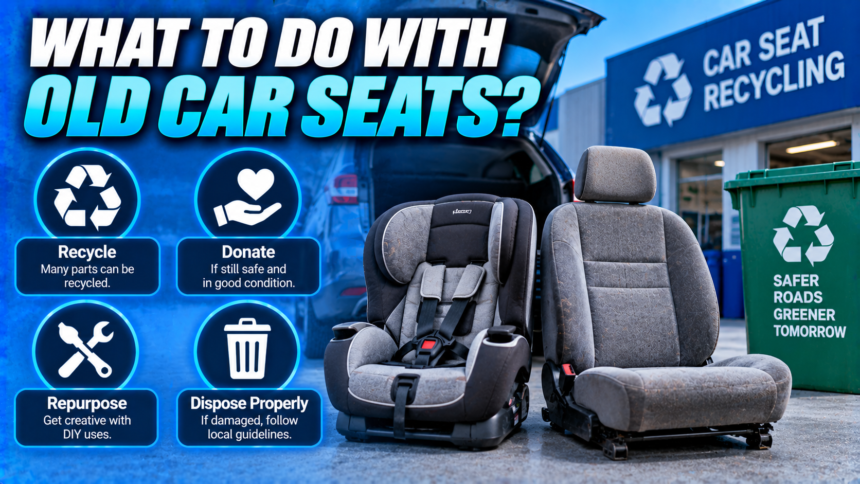
Everything hinges on one question: is the seat still safe for a child to ride in? If it is, you can pass it on to someone you know. If it is not, the seat is not a hand-me-down, it is a recycling job, and the plastic shell needs to be made unusable before it leaves your house.
- First, work out whether the seat is still usable
- If the seat is still good
- Bases, boosters, and the loose bits
- If the seat is done: four ways to get rid of it
- How to destroy a car seat before you bin it
- Why an expired seat should not be donated or sold
- Planning around the trade-in calendar
- What happens to a recycled seat
- Conclusion
- Frequently asked questions
- Related Articles
Most seats that pile up in a garage fall into the second group. They have expired, been through a crash, or lost a part. This page walks through how to tell which group yours is in, then exactly what to do with it either way.
First, work out whether the seat is still usable
Run through these five questions. A no to any one of them means the seat is finished.
- Is it inside its expiration date? Look for a stamped or printed date on the shell, on a label on the base, or on the underside. Most seats are good for six to ten years from the date of manufacture, and the exact figure varies by brand and model.
- Has it ever been in a crash? A seat that was in a moderate or severe crash is done, even if it looks perfect.
- Do you know its full history? If you cannot personally vouch for where the seat has been, you cannot rule out a crash. That alone rules out most secondhand seats.
- Is it free of recalls? Look up the model on the manufacturer’s site or the federal recall database.
- Are all the parts there and undamaged? Harness, buckle, chest clip, cover, base, and instruction manual. Cracked plastic, frayed webbing, or a buckle that does not click firmly all end it.
On the crash question, the federal guidance is precise. A crash counts as minor, and the seat may be reused, only when every one of the following is true: the car could be driven away, the door nearest the seat was undamaged, nobody in the car was injured, no airbags deployed, and the seat shows no visible damage. The full wording sits on NHTSA’s page on car seat use after a crash. If any single item on that list fails, the seat is scrap.
If the seat is still good
You have real options here, and the safest ones are the ones where the next family knows exactly what they are getting.
Hand it to a friend or relative directly, along with the manual and the expiration date written on a note. Someone who can ask you about its history is in a far better position than a stranger buying from an online listing.
Some family shelters, refugee resettlement groups, and hospital programs accept in-date seats with a known history, but many will not take any secondhand seat at all as a matter of policy. Call first rather than turning up with it, and expect a no more often than a yes.
Selling it is legal and some resale platforms specialise in checked baby gear, but be honest in the listing about the manufacture date, the expiry, and whether the seat has ever been in a crash. A buyer who does not know those three things cannot make a safe decision.
Keep a seat only if you have a specific child who will use it before it expires. Storing a seat “just in case” usually means it expires in the attic, and a hot attic ages the plastic faster than the car did.
Bases, boosters, and the loose bits
An infant seat and its base are two separate products with two separate expiry dates, and they usually differ. A base often outlasts the carrier it came with, which is why you can end up with a perfectly good base and a dead seat, or the reverse. Neither half is useful on its own, so both go the same way when one fails.
Booster seats expire too, even the backless ones with no harness at all. The shell and the belt guides are still structural, and the same plastic ageing applies. Boosters are also the seats most likely to be handed round between families without anyone checking a date, so they are worth a look if you have a stack of them.
Trade-in events and recycling programs generally take all three, seats, bases, and boosters, as separate items. If you are clearing out a whole set, take the lot in one trip.
If the seat is done: four ways to get rid of it
| Route | What you get | Effort |
| Retailer trade-in event | A discount coupon, seat taken off your hands | Low, but only during the event window |
| Local recycling program | Free or low-cost drop-off, materials recovered | Medium, depends on your area |
| Mail-in or manufacturer program | Proper recycling anywhere in the country | Medium, often a fee |
| Household trash | Nothing, but it is always available | Low, after you destroy the seat |
Retailer trade-in events are the easiest route when the timing works. Target runs one twice a year, in spring and again in autumn, and takes any car seat, booster, or infant base, whether it is expired, damaged, crashed, or simply outgrown. You drop it in a collection box near guest services, scan the code on the box with the Target app, and a 20 percent coupon lands in your Target Circle account for a new seat, a stroller, or select baby gear. Dates shift each year, so check the current window on Target’s car seat trade-in page before you load the car.
Local recycling programs are the underused option. Several state transportation departments run free drop-off schemes, and children’s hospitals, fire departments, and county waste facilities often collect seats on set days each month. Search your state’s transport or safety department alongside “car seat recycling” rather than searching generic recycling directories, which tend to miss these.
Mail-in and manufacturer programs exist for people with no local option. These usually charge a fee that covers shipping and dismantling. It is the most expensive route, and it is the only one that works everywhere.
Household trash is the fallback, and there is no shame in it if you have exhausted the others. Just do the next section first.
How to destroy a car seat before you bin it
This step matters more than the recycling. A whole-looking seat left at the kerb gets picked up, and the person who takes it has no idea it expired in 2019 or went through a side impact.
- Cut the harness straps, the top tether, and any LATCH straps. Cut them through, not just loose.
- Remove the fabric cover and the padding.
- Take off or scribble out the label showing the model and manufacture date.
- Write “EXPIRED, DO NOT USE” across the shell in permanent marker, large enough to read from a distance.
- Bag the shell in an opaque sack so it is not visible in the bin.
If your local scheme takes rigid plastics, the bare shell may be accepted once it is stripped. The foam, fabric, and metal usually have to be separated out, which is exactly what the organised recycling programs do for you.
Check the rules for bulky waste in your area too. Many councils and haulers will not take a car seat in a normal bin, and some apartment complexes specifically ban them because of their size.
Why an expired seat should not be donated or sold
The reason is simple and it is worth stating plainly: nobody downstream can inspect a car seat for the damage that matters.
The plastic in a car seat shell is petroleum based, and it lives in a car that swings between freezing and well over 100 degrees Fahrenheit inside. That cycling makes the plastic more brittle over years, and brittleness does not show up as a crack you can see. Standards move too, so a seat that passed the tests of its era may sit below what a current seat has to meet on side impact or harness design.
Then there is history. Crash damage to a shell is frequently invisible, which is the whole reason the guidance is written around what happened to the car rather than what the seat looks like. A stranger buying your seat cannot verify any of that.
Planning around the trade-in calendar
If your seat is already unusable, a little timing saves real money.
The spring and autumn trade-in windows are the moment to replace a seat you were going to replace anyway. Twenty percent off a car seat or travel system is worth considerably more than the seat you are handing over.
The coupon usually covers strollers and some baby home gear as well, not only car seats, which is useful when you are aging out of the whole setup rather than buying another seat.
If your seat expires in a few months and an event is coming, waiting is reasonable. If it has already expired, take it out of the car now and put it aside until the event. An expired seat should not be in service while you wait for a discount.
What happens to a recycled seat
The seat gets dismantled rather than shredded whole. Metal parts go one way, the fabric and foam another, and the rigid plastic shell is cleaned, ground, and reprocessed into pellets that become new moulded goods.
Target reports diverting more than 1.25 million pounds of car seat plastic from landfill since 2022, feeding it into storage and home products sold back through its own stores. That is the useful thing to understand about these programs. The seat does not become another car seat, it becomes a bin or a crate, and the point is keeping several pounds of durable plastic out of the ground.
Conclusion
Check the expiry, the crash history, and the parts. A seat that passes all three can go to someone you know, with the dates written down for them. A seat that fails any one of them goes to a trade-in event, a local recycling drop-off, or, as a last resort, the bin with the straps cut and the shell marked. The one thing to avoid is putting an unverifiable seat into a stranger’s car.
Frequently asked questions
Can I donate an expired car seat?
No, and most charities will not accept one. An expired shell may be brittle in ways nobody can see, and the next family has no way to check its history. Recycle it or destroy it instead.
How do I find my car seat’s expiration date?
Look for a moulded or printed date on the shell, a sticker on the base, or the underside of the seat. Some list an expiry directly, others give the manufacture date plus a lifespan in the manual.
Does Target take any car seat?
Their trade-in events accept car seats, boosters, and infant bases in any condition, including expired, damaged, and crashed ones. The events run twice a year, so check the current dates before going.
Can I just put a car seat in the recycling bin?
Not usually. Kerbside recycling rarely accepts them because they combine plastic, metal, foam, and fabric. Use a dedicated drop-off program, or strip the seat and put the shell in the household waste.
What if my seat was only in a small crash?
It may still be usable, but only if every federal criterion is met: the car drove away, the nearest door was undamaged, nobody was hurt, no airbags went off, and the seat looks undamaged. Otherwise replace it.
Related Articles
Where to Put Jack Stands on a Car: Safe Placement Points
Why Is My Car Shaking? How to Find the Cause