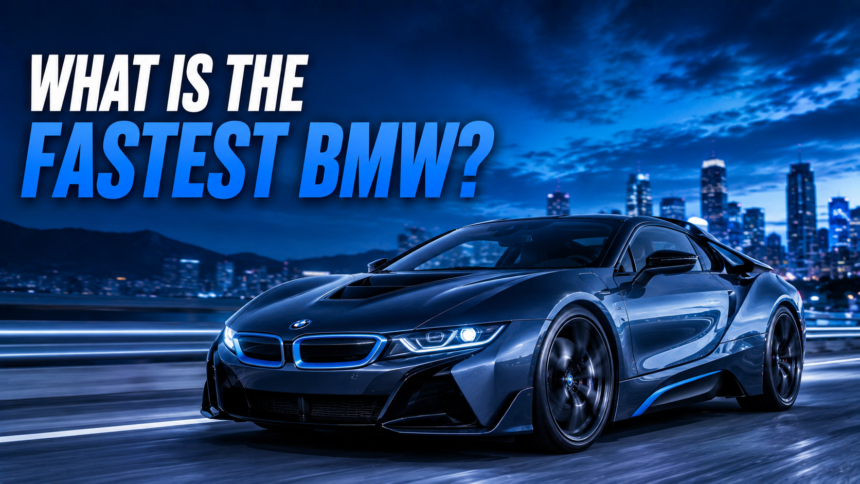
If you have ever found yourself scrolling through car forums late at night, chances are you have typed the question “what is the fastest BMW” into a search bar at least once. It is a fair question, because BMW builds one of the widest performance lineups of any car brand in the world. From family-friendly sedans with hidden fire under the hood to full-blown M division monsters, the Bavarian automaker has spent decades chasing speed in almost every shape and size imaginable.
This guide is meant to answer that question in plain language, without drowning you in jargon. We will look at top speed, acceleration, the difference between the two, and how BMW’s newest electric models are shaking up the conversation. By the end, you should have a clear picture of which BMW deserves the title of fastest, and why the answer depends a little on how you define “fast” in the first place.
How BMW Measures “Fastest”
Before ranking anything, it helps to understand that “fastest” is not a single number. A car can be blisteringly quick off the line but still have a lower top speed than a car that accelerates more gradually. BMW, like most manufacturers, separates performance into a few different categories.
Top speed refers to the maximum velocity a car can physically reach, usually tested on a closed track or an unrestricted stretch of highway such as the German Autobahn. Acceleration, on the other hand, usually refers to the 0-60 mph (or 0-100 km/h) sprint, which measures how quickly a car can get moving from a standstill.
Most BMW models are electronically limited to 155 mph out of the factory for safety and tire-durability reasons. However, buyers who select the optional M Driver’s Package can raise that limiter to 190 mph on certain M models. This distinction matters a lot when someone asks what is the fastest BMW, because the answer changes depending on whether the limiter was removed or left in place.
It is also worth noting the difference between factory-claimed figures and independent third-party testing. Automakers tend to be slightly conservative with their official numbers, so real-world testing by outlets like Car and Driver or Motor Trend sometimes shows quicker results than BMW’s own press materials.
Fastest BMW by Top Speed
When it comes to outright top speed, the BMW M5 CS typically sits at the top of the conversation among modern production BMWs. With the M Driver’s Package, it is capable of reaching 190 mph, making it one of the quickest four-door sedans in the world in a straight line.
Close behind is the BMW M8 Competition, BMW’s flagship grand tourer, which shares a similar top speed rating when equipped with the same package. The X5 M and X6 M Competition, BMW’s high-performance SUVs, also reach an electronically limited 177 to 190 mph depending on configuration, which is remarkable for vehicles of that size and weight.
Here is a quick comparison table of some of BMW’s fastest models by top speed:
| Model | Top Speed (with M Driver’s Package) | Notes |
|---|---|---|
| BMW M5 CS | 190 mph | Fastest production BMW sedan |
| BMW M8 Competition | 190 mph | Grand tourer coupe/convertible |
| BMW X5 M Competition | 177-190 mph | Performance SUV |
| BMW X6 M Competition | 177-190 mph | Performance SUV coupe |
| BMW i8 (discontinued) | 155 mph | Hybrid sports car, historical reference |
Fastest BMW by 0-60 mph Acceleration
If raw acceleration is more your concern than outright top speed, the picture shifts slightly. All-wheel-drive BMW M models tend to launch off the line faster than their rear-wheel-drive counterparts because they can put power down more effectively without wheel spin.
The BMW M5 CS again leads the pack here, capable of hitting 60 mph in roughly 2.9 seconds thanks to its twin-turbocharged V8 engine, xDrive all-wheel-drive system, and launch control. That number puts it in the same territory as some dedicated supercars.
Below is a general ranking of some of the quickest BMWs by acceleration:
- BMW M5 CS – approximately 2.9 seconds
- BMW M8 Competition xDrive – approximately 3.0 seconds
- BMW X5 M Competition – approximately 3.0 seconds
- BMW M3 Competition xDrive – approximately 3.4 seconds
- BMW M4 Competition xDrive – approximately 3.5 seconds
The takeaway here is that all-wheel drive, forced induction, and launch control together create the winning formula for a rapid sprint to 60 mph, even if the car’s ultimate top speed is not the highest on the list.
Fastest BMW M Models: A Closer Look
The M badge is where BMW concentrates most of its performance engineering, so it is worth taking a closer look at a few standout models.
The BMW M5 CS deserves the flagship title. It combines a twin-turbo 4.4-liter V8 producing 627 horsepower with a lightweight, track-focused chassis. It is the quickest and most powerful M5 BMW has ever built, and for many enthusiasts, it is the definitive answer to what is the fastest BMW currently in production.
The BMW M8 Competition takes a slightly different approach, favoring long-distance comfort alongside serious speed. It shares much of its powertrain DNA with the M5 but wraps it in a more grand-touring-oriented body, available as either a coupe or convertible.
For buyers who want M-level performance in a smaller, more affordable package, the M3 Competition and M4 Competition remain excellent choices. They are not the outright fastest BMWs on this list, but they offer a thrilling balance of speed, agility, and everyday usability that larger M cars sometimes sacrifice.
Finally, BMW’s M Performance SUVs, the X5 M and X6 M Competition, prove that size does not have to mean slow. These are genuinely quick vehicles that can keep pace with dedicated sports sedans in a straight line, all while offering practical seating and cargo space.
Fastest Electric BMW
Electric power has changed the performance conversation across the entire auto industry, and BMW is no exception. Electric motors deliver instant torque, which means even non-M electric BMWs can accelerate surprisingly quickly.
The BMW i5 M60 and i4 M50 are strong examples, both capable of reaching 60 mph in the mid-3-second range thanks to dual electric motors and all-wheel drive. The BMW iX M60, an electric SUV, follows a similar pattern, offering supercar-like acceleration in a family-sized package.
While these electric models are not yet BMW’s outright quickest in terms of top speed, since they are limited for battery and efficiency reasons, they are closing the acceleration gap with combustion-powered M cars faster than many expected. It is entirely possible that within the next few years, an electric BMW will claim the title of fastest overall.
Historical Fastest BMWs
BMW’s pursuit of speed did not start with today’s turbocharged, all-wheel-drive monsters. Decades ago, models like the E39 generation M5 and the E46 M3 CSL were considered blisteringly fast for their era, even though their numbers look modest compared to today’s standards.
Looking back at this evolution helps put modern performance into perspective. A car that needed around 5 seconds to reach 60 mph in the early 2000s was considered a genuine performance icon. Today, that same time is achievable by several non-M BMW models with a turbocharged four-cylinder engine. Technology, particularly in turbocharging, all-wheel drive, and now electrification, has fundamentally reshaped what “fast” means for the brand.
Factors That Affect BMW Speed
Several engineering factors determine how quickly a BMW can accelerate and how fast it can ultimately go. Understanding them helps explain why some models outperform others despite having similar horsepower figures.
Engine type plays a major role. Turbocharged inline-six and V8 engines provide strong low-end torque, while hybrid and fully electric powertrains offer instant torque delivery from a standstill. Weight and aerodynamics also matter significantly; a lighter car with a slippery shape will generally accelerate faster and reach a higher top speed than a heavier one with the same power output.
Drivetrain layout is another key factor. BMW’s xDrive all-wheel-drive system generally allows for quicker acceleration than rear-wheel-drive alternatives because it distributes power to all four wheels, reducing wasted wheel spin. Finally, transmission tuning, including how quickly a car can shift gears under hard acceleration, has a noticeable impact on real-world 0-60 mph results.
Fastest BMW vs. Competitors
BMW does not build its fastest models in a vacuum. It competes directly with Mercedes-AMG, Audi RS, and Porsche in the high-performance segment.
The Mercedes-AMG E63 S and Audi RS6 Avant are frequently cross-shopped against the BMW M5 CS, and all three offer similar performance figures in the sub-3.5 second 0-60 mph range. Porsche, meanwhile, competes more directly in the sports car space with models like the 911 Turbo S, which can edge out even the M5 CS in outright acceleration, though it is a smaller two-door car rather than a practical sedan.
This rivalry pushes all these manufacturers to continually refine their fastest offerings, which is good news for enthusiasts who benefit from the ongoing competition.
Frequently Asked Questions
What is BMW’s fastest 0-60 mph car? The BMW M5 CS currently holds that title among production BMWs, reaching 60 mph in approximately 2.9 seconds.
Is the M5 CS faster than the M8? The M5 CS is generally quicker in a straight line due to its lighter weight, though both share a similar top speed when equipped with the M Driver’s Package.
Does BMW limit top speed on all models? Most BMW models are electronically limited to 155 mph. Certain M models can be optioned with the M Driver’s Package to raise that limit to 190 mph.
What is the fastest BMW under $100,000? The BMW M3 Competition xDrive and M4 Competition xDrive typically fall under that price point while still offering 0-60 mph times in the low 3-second range.
Conclusion
So, what is the fastest BMW available today? By nearly every measure, that title belongs to the BMW M5 CS, which combines the quickest acceleration and one of the highest top speeds in BMW’s current lineup. For buyers who want a similar experience with more everyday comfort, the M8 Competition is a strong alternative, while the M3 and M4 Competition models offer a more accessible entry point into serious BMW performance.
Looking ahead, electric models like the i5 M60 and iX M60 suggest that BMW’s definition of “fastest” will keep evolving. Whether you prioritize outright top speed, quick acceleration, or day-to-day usability, BMW’s current lineup has a genuinely fast option for nearly every kind of driver.
Related Articles
How Many Miles Can a Honda Odyssey Last? Full Lifespan Guide
What to Put Under Tires When Storing a Car?