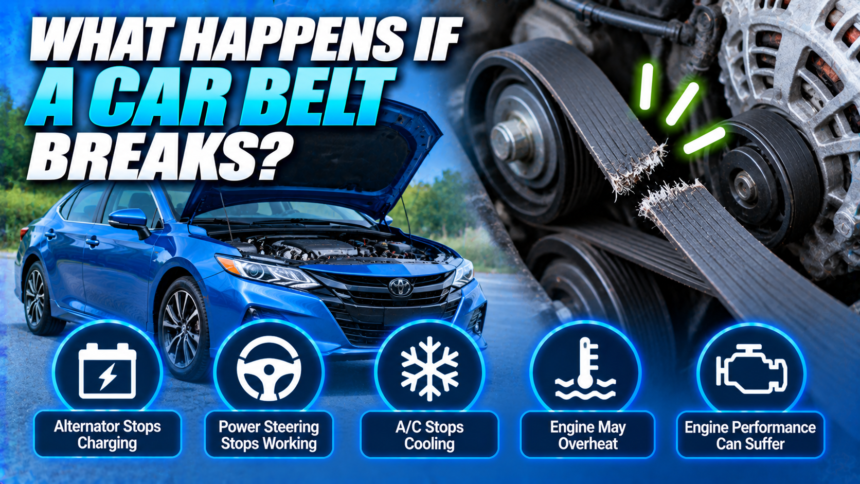
It depends which belt, and the difference is enormous. If the serpentine belt snaps, the engine keeps running but you immediately lose power steering, battery charging, and usually cooling, so you have a few minutes to get somewhere safe. If the timing belt snaps, the engine stops dead on the spot, and on most modern cars the engine damages itself in the same instant.
- Which belt do you mean?
- If the serpentine belt breaks
- What to do at the roadside: serpentine belt
- If the timing belt breaks
- Interference engines and why they matter
- What to do at the roadside: timing belt
- What the repair involves
- Warning signs before a belt goes
- Preventing both
- Conclusion
- Frequently asked questions
- Can you drive with a broken serpentine belt?
- Does a broken timing belt always destroy the engine?
- How do I know if my car has an interference engine?
- Why should I not try to restart after a timing belt breaks?
- How often should a timing belt be replaced?
- Related Articles
One is an inconvenience with a deadline attached. The other is often the end of the engine. So the first thing worth establishing is which one you are dealing with.
Which belt do you mean?
Cars have two quite different belts, and people searching this question rarely know which one has gone.
| Serpentine belt | Timing belt | |
| Where it is | Outside the engine, visible when you open the bonnet | Inside, behind a cover, not normally visible |
| What it drives | Alternator, power steering, AC, often the water pump | Crankshaft and camshaft synchronisation |
| Engine when it breaks | Keeps running | Stops instantly |
| Typical outcome | Accessories lost, overheating follows | Often severe internal damage |
| Rough repair scale | Low | Low if lucky, very high if not |
The quickest way to tell at the roadside is whether the engine is still running. A serpentine belt failure leaves the engine running perfectly happily while warning lights appear and the steering goes heavy. A timing belt failure cuts the engine instantly, as though someone turned the key off, and it will not restart.
One complication worth knowing: some cars use a timing chain instead of a belt, which is designed to last the life of the engine and is not a scheduled replacement item. If your car has a chain, the timing belt scenario below does not apply in the same way, though a badly stretched chain can jump and cause similar damage.
If the serpentine belt breaks
This is the better outcome, and it is a manageable situation if you act quickly.
The serpentine belt is a single long belt winding around pulleys on the front of the engine, driving the accessories. When it snaps, all of them stop at once.
- Power steering goes. The wheel becomes very heavy, particularly at low speed. The car is still steerable, but it takes real effort and it catches people out at the moment it happens.
- The battery stops charging. The alternator has stopped, so the car is running purely off the battery. The battery light comes on, and you have perhaps twenty to forty minutes before the electrical system fails entirely.
- Cooling usually stops. On many cars the same belt drives the water pump. Coolant stops circulating and the temperature climbs quickly.
- The air conditioning stops. Least important, but often the first thing people notice.
The overheating is what turns a cheap repair into an expensive one. A belt is inexpensive; a cylinder head warped by driving on with no coolant circulation is not.
What to do at the roadside: serpentine belt
- Take the heaviness of the steering into account before you do anything else. Both hands on the wheel, and expect to need force, especially as you slow down.
- Watch the temperature gauge. It is now the thing that matters most.
- Get off the road promptly. You have a short window, so use it to reach somewhere safe rather than trying to reach home.
- Switch the engine off once stopped. Every minute it runs without coolant circulation adds heat.
- Do not restart it to move a little further. That is how people convert a belt failure into head gasket damage.
- Call for recovery. This is a tow, not a limp home, unless you are certain your water pump is driven separately and you are very close.
Open the bonnet once things have cooled and you will usually see the evidence: shredded rubber draped over the pulleys, or nothing at all where the belt used to be. Sometimes the belt is still there but has come off its pulleys, which points at a failed tensioner or a seized accessory rather than the belt itself.
If the timing belt breaks
This is the serious one.
The timing belt keeps the crankshaft and camshaft turning in exact synchronisation, so that valves open and close at precisely the right moment relative to the pistons. It does this thousands of times a minute.
When it snaps, the camshaft stops immediately while the crankshaft keeps spinning under the engine’s own momentum. The valves freeze wherever they happened to be, some of them open, while the pistons keep travelling up their bores.
What happens next depends on how your engine was designed, which brings us to the distinction that decides everything.
Interference engines and why they matter
In an interference engine, the pistons and the valves pass through the same space at different moments. That overlap allows larger valves and higher compression, so it is efficient, and it is how most modern engines are built.
Take away the synchronisation and that shared space becomes a collision. Pistons strike open valves at speed. Valves bend, and in worse cases pistons crack, valve guides fail, camshaft lobes are damaged, or the cylinder head is cracked.
In a non-interference engine, the two never occupy the same space regardless of timing. The belt breaks, the engine stops, and nothing inside is harmed. You need a tow and a new belt, and that is the whole repair.
Which type you have is a matter of engine design rather than brand, and it is worth knowing before you ever need it. Your handbook, a marque forum, or a workshop can tell you in moments. This explanation of interference versus non-interference engines sets out how to confirm it and how damage is verified afterwards.
Do not assume you have escaped simply because the engine turns over. Occasionally an interference engine stops in a fortunate position and survives, but that is luck rather than a rule, and it has to be confirmed by testing rather than hoped for.
What to do at the roadside: timing belt
- Coast to safety. The engine has stopped, so power steering and brake assistance have gone with it. The brakes still work but need much harder pressure, and the steering is heavy.
- Stop trying to start it. This is the single most important instruction here.
- Turn the ignition off and leave it off.
- Call for recovery, and mention that you suspect the timing belt so the right equipment turns up.
Every time you crank an engine after a timing belt has broken, you drive pistons into open valves again. Someone who tries repeatedly to restart can turn a survivable failure into a destroyed engine.
That instruction is worth repeating because the instinct is exactly the opposite. The engine has stopped suddenly, so the natural response is to turn the key and see. Resist it.
What the repair involves
For a serpentine belt, the job is straightforward: a new belt, and usually an inspection of the tensioner and pulleys, since a belt that has failed early often failed because something else was dragging or misaligned. It is one of the cheaper repairs on a car.
For a timing belt on a non-interference engine, it is a belt replacement plus the labour of getting to it, which is more involved because the belt sits behind covers and often behind other components.
For a timing belt on an interference engine, the first step is finding out what was damaged. A compression test, a leak-down test, or a borescope through the spark plug holes will show whether valves are bent without stripping the engine. If they are, the cylinder head comes off and the damage is assessed properly.
At that point the arithmetic becomes about the car rather than the engine. Head repair on a sound, well-kept car often makes sense. On a high-mileage car with other problems, a used engine or moving the car on may be the better decision. It is worth getting the diagnosis before deciding, because the range of outcomes is wide.
Warning signs before a belt goes
A serpentine belt usually gives notice. Squealing on start-up or when you turn the wheel, a chirping noise, visible cracking or glazing on the ribbed side, or a battery light that flickers at idle all suggest it is slipping or worn. Fraying edges and missing chunks mean it is close.
A timing belt often gives no warning at all, which is precisely why it is replaced on a schedule rather than on condition. It sits behind a cover where you cannot see it, and it can look serviceable shortly before it fails. Occasional signs include a ticking from the front of the engine, rough running, or oil leaking near the timing cover, since oil degrades the rubber.
The absence of symptoms is not evidence of health on a timing belt. That is the trap.
Preventing both
Replace the timing belt at the interval in your handbook, typically somewhere between sixty and a hundred thousand miles, or on a time basis of several years, whichever comes first. Time matters because rubber degrades whether the car is driven or not, so a low-mileage older car still needs it.
Have the tensioner, idler pulleys, and often the water pump replaced at the same time. Most of the cost is labour to reach the belt, so replacing the surrounding parts while everything is apart is far cheaper than doing it twice.
If you are buying a used car, ask for evidence the timing belt has been done. No paperwork means budget for it immediately and treat that as part of the purchase price.
For the serpentine belt, have it inspected at services and replace it when it starts to crack or squeal rather than waiting for it to let go.
Conclusion
If the engine is still running, it is the serpentine belt: expect heavy steering, a battery light, and rising temperature, and get off the road quickly before overheating causes real damage. If the engine stopped instantly and will not restart, suspect the timing belt, and stop turning the key, because every attempt risks driving pistons into open valves. Then have the engine assessed before assuming the worst or the best, and treat the timing belt interval in your handbook as a firm date rather than a suggestion.
Frequently asked questions
Can you drive with a broken serpentine belt?
Only far enough to stop safely. You lose power steering and battery charging, and on most cars the water pump too, so the engine begins overheating within minutes. Driving on risks warping the cylinder head.
Does a broken timing belt always destroy the engine?
No, but on an interference engine it usually causes damage, since pistons strike open valves. Non-interference engines simply stop with no internal harm. Testing is the only way to confirm which happened.
How do I know if my car has an interference engine?
Check the handbook, a marque owners’ forum, or ask a workshop with your engine code. It depends on engine design rather than manufacturer, and it is worth knowing before the belt is due.
Why should I not try to restart after a timing belt breaks?
Because cranking turns the crankshaft while the camshaft stays put, driving pistons into open valves again. Repeated attempts can turn limited damage into a destroyed engine.
How often should a timing belt be replaced?
Typically every sixty to a hundred thousand miles, or every few years, whichever comes first. Rubber degrades with age as well as use, so a low-mileage car still needs replacement on schedule.
Related Articles
Why Is My Car Smoking From the Hood? What It Means
How Do the Fins Help in Radiator Cooling? A Complete Guide for Drivers