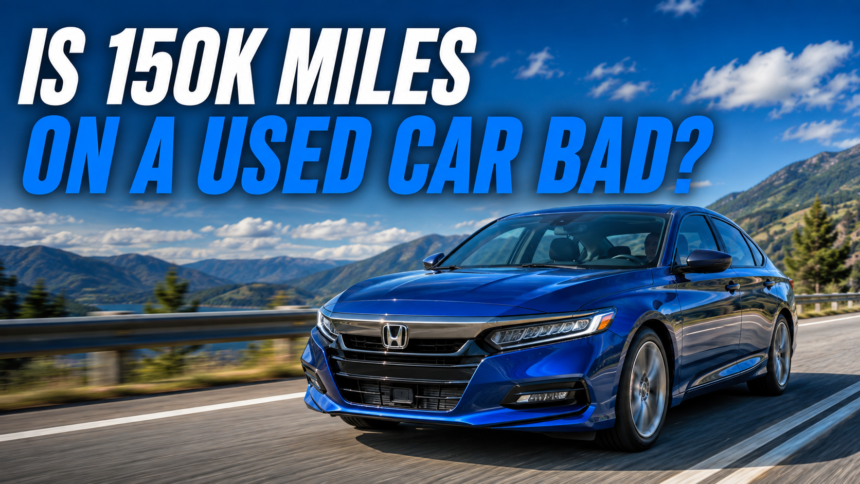
If you’re shopping for a used car and keep hesitating every time you see “150,000 miles” in the listing, you’re not alone. It’s one of the most common questions car buyers type into Google before making a decision. The short answer is that 150k miles on a used car is not automatically bad. In fact, many vehicles with this much mileage still have years of reliable service left in them. The real story depends on how the car was driven, how well it was maintained, and what condition it’s in today — not just the number on the odometer.
- What Does 150,000 Miles Actually Mean for a Car?
- Average Lifespan of Cars Today
- Factors That Matter More Than Mileage
- Maintenance History and Service Records
- Highway Miles vs. City/Stop-and-Go Miles
- Number of Previous Owners
- How the Car Was Stored
- Age of the Car vs. Mileage
- Reliable Brands and Models That Handle High Mileage Well
- What to Inspect Before Buying a 150k-Mile Car?
- Questions to Ask the Seller
- Pros and Cons of Buying a 150k-Mile Car
- Cost Considerations
- Get a Pre-Purchase Inspection (PPI)
- When 150k Miles IS a Red Flag?
- Frequently Asked Questions
- Conclusion
- Related Articles
This guide breaks down everything you need to know so you can make a confident, informed decision instead of walking away from a perfectly good car out of fear, or buying a problem car because the mileage seemed “acceptable.”
What Does 150,000 Miles Actually Mean for a Car?
To put 150,000 miles into perspective, it helps to know how much the average driver puts on their car each year. Most estimates place average annual mileage somewhere between 12,000 and 15,000 miles. Using that math, a car with 150,000 miles has typically been driven for about 10 to 12 years.
That means when you’re looking at a 150k-mile car, you’re usually looking at a car that’s roughly a decade old — not a brand-new vehicle that was driven unusually hard in a short period. Context matters here. A 3-year-old car with 150,000 miles tells a very different story than a 12-year-old car with the same number, and we’ll get into why below.
Average Lifespan of Cars Today
Cars built today are simply engineered to last longer than they were 20 or 30 years ago. Improvements in engine technology, materials, oil formulations, and manufacturing tolerances mean that many modern vehicles are capable of running well past 200,000 miles, and some well-maintained examples reach 300,000 miles or more.
This is a big shift from decades past, when 100,000 miles was often considered the end of a car’s useful life. Today, that same number is frequently just the midpoint. So when someone asks, “is 150k miles on a used car bad?”, the more accurate modern answer is that it often represents a car in the middle of its life rather than near the end of it.
Factors That Matter More Than Mileage
Mileage is just one data point. The following factors often matter far more when judging whether a high-mileage car is a smart buy.
Maintenance History and Service Records
A car with 150,000 miles and a complete, documented service history — regular oil changes, fluid flushes, timely part replacements — is almost always a safer bet than a car with 60,000 miles and no records at all. Consistent maintenance is the single biggest factor in how long an engine and transmission will last.
Highway Miles vs. City/Stop-and-Go Miles
Not all miles are created equal. Highway miles are gentler on a car because the engine runs at a steady, efficient RPM with less strain from constant starting, stopping, and idling. City driving, by contrast, involves more wear on the brakes, transmission, and engine due to frequent acceleration and stop-and-go traffic. A car with 150,000 mostly highway miles is often in better mechanical shape than a car with far fewer miles racked up entirely in heavy city traffic.
Number of Previous Owners
A car that’s had one careful owner for its entire life is generally a better sign than a car that’s changed hands five times in ten years. Frequent ownership turnover can sometimes (though not always) indicate underlying issues that previous owners were trying to avoid dealing with.
How the Car Was Stored
A vehicle kept in a garage and shielded from extreme weather, road salt, and sun exposure will typically show less wear — especially less rust and less interior/exterior degradation — than a similar car that spent its life parked outside.
Age of the Car vs. Mileage
It’s a common misconception that low mileage always equals a better car. In reality, a car that’s 15 years old with only 40,000 miles can sometimes have more problems than a 150,000-mile car driven regularly. Rubber components, seals, belts, and fluids degrade with age and time — not just with mileage. A car driven regularly and maintained on schedule often ages better mechanically than one that sat idle for long stretches.
Reliable Brands and Models That Handle High Mileage Well
Some brands and models have earned strong reputations for durability well beyond 150,000 miles. The table below summarizes a few widely recognized examples.
| Brand/Model | Known Strength |
|---|---|
| Toyota Camry, Corolla, RAV4 | Renowned for engine longevity and low mechanical failure rates |
| Honda Civic, Accord, CR-V | Strong reliability history, especially with regular maintenance |
| Lexus (most models) | Toyota-engineered reliability with added refinement |
| Subaru Outback/Forester | Durable engines, though head gasket issues on older models are worth checking |
On the other hand, some luxury and performance-oriented brands can be more expensive and complicated to maintain at high mileage, since their parts and labor costs tend to be higher and some models are more prone to costly electronic or mechanical issues as they age. This doesn’t mean they’re bad cars — it simply means the cost of ownership at high mileage deserves closer scrutiny.
What to Inspect Before Buying a 150k-Mile Car?
Before committing to a used car with significant mileage, there are several specific things worth checking closely.
- Timing belt/chain replacement history – On many engines, the timing belt needs replacement around 90,000–120,000 miles. If it’s never been replaced on a 150k-mile car, that’s a repair you’ll likely need to budget for soon, since failure can cause serious engine damage.
- Transmission condition – Ask about fluid changes and pay attention to shifting smoothness during a test drive.
- Engine oil condition and leaks – Check for sludge buildup, unusual smells, or visible leaks under the car.
- Rust and undercarriage check – Especially important in areas with harsh winters or road salt use.
- Tires, brakes, and suspension wear – These are normal wear items but can add up in cost if all need replacing soon.
- Electrical systems and dashboard warning lights – Test all electronics, and don’t ignore a check-engine light, even if the seller says “it’s nothing.”
Questions to Ask the Seller
A short conversation with the seller can reveal a lot. Useful questions include asking for maintenance and repair records, asking directly why they’re selling the car, asking whether it’s ever been in an accident or had major repairs, and requesting a vehicle history report such as a CarFax or AutoCheck to confirm the ownership timeline and accident history.
Pros and Cons of Buying a 150k-Mile Car
| Pros | Cons |
|---|---|
| Lower purchase price than newer, low-mileage cars | Higher likelihood of upcoming repairs |
| Slower depreciation from this point forward | Shorter remaining resale window |
| Often still has years of reliable use left | May not qualify for extended manufacturer warranties |
| Can be a smart budget-friendly option if well-maintained | Financing terms may be less favorable on older vehicles |
Cost Considerations
Buying a high-mileage car usually means a lower upfront cost, but it’s worth weighing that savings against the possibility of near-term repairs. Setting aside a maintenance buffer — even a modest one — can help absorb costs like brake jobs, a timing belt service, or tire replacement that may come up sooner than they would on a newer vehicle.
Insurance costs are also worth checking, since older, higher-mileage vehicles are sometimes cheaper to insure due to lower replacement value, though this varies by insurer and vehicle type. Some companies also offer extended or aftermarket warranties designed specifically for higher-mileage vehicles, which can provide peace of mind for a predictable monthly or upfront cost.
Get a Pre-Purchase Inspection (PPI)
This step is genuinely non-negotiable. A pre-purchase inspection by an independent, trusted mechanic — not one recommended by the seller — is the single best way to know what you’re actually buying. A mechanic will check the engine, transmission, brakes, suspension, electrical systems, and look for signs of prior accident damage or fluid leaks that aren’t obvious during a test drive.
A PPI typically costs somewhere between $100 and $200, which is a small price to pay compared to discovering a major mechanical issue after the sale.
When 150k Miles IS a Red Flag?
While 150,000 miles isn’t inherently bad, there are situations where it should raise real concern. Be cautious if there are no service records at all, if the car shows obvious signs of neglect such as dirty oil, worn-out interior, or ignored warning lights, if the vehicle history shows multiple owners in a short span of time, or if the car has a salvage title or history of major accident damage. In these cases, the mileage isn’t really the problem — it’s a signal that the car wasn’t cared for, and that pattern is likely to continue.
Frequently Asked Questions
Is 150k miles high for a car? It’s above average for a car’s midpoint but not unusually high by modern standards. Many reliable vehicles run well past 200,000 miles with proper care.
What’s considered “too many miles” on a used car? There’s no fixed number. A well-maintained car with 200,000 miles can be a better buy than a neglected car with 80,000 miles.
Should I buy a car with 150k+ miles? Yes, if it has solid maintenance records, passes a pre-purchase inspection, and comes from a brand known for durability.
How many more years will a 150k-mile car last? With regular maintenance, many cars can run for several more years and tens of thousands of additional miles beyond that point.
Does mileage affect insurance? It can, though it varies by insurer. Higher-mileage vehicles sometimes cost less to insure due to lower replacement value.
Conclusion
So, is 150k miles on a used car bad? On its own, no — it’s simply a number, and modern vehicles are built to handle far more than that when properly maintained. What really determines whether a high-mileage car is a smart buy is its service history, how it was driven, how it was stored, and its current mechanical condition.
Before you buy, request maintenance records, ask the seller direct questions, pull a vehicle history report, and always get a pre-purchase inspection from an independent mechanic. Do that, and 150,000 miles might just turn out to be a smart, budget-friendly choice rather than something to fear.
Related Articles
Why Does My Car Shake When I Drive? A Complete Guide to Causes, Fixes, and Costs
Brake Pedal Locked and Car Won’t Start? Here’s Why
How Many Engine Mounts Does a Car Have?