


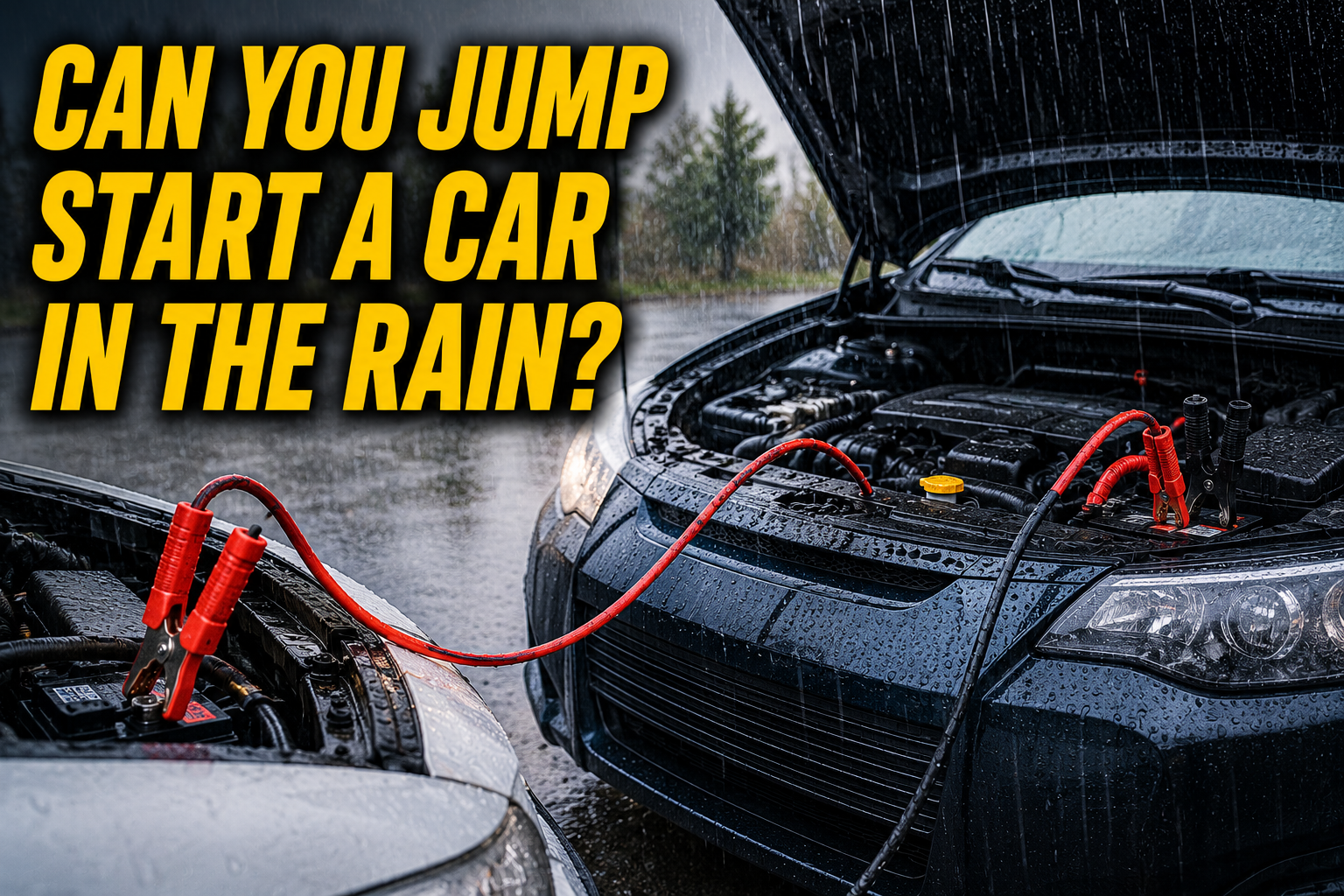
Yes. Jump starting a car in the rain is safe, and the electrocution most people are worried about is not a realistic risk. A car battery runs at 12 volts, which is far too low to push a dangerous current through a human body, wet or dry.
- Why the electrocution fear is misplaced?
- The risks that are real
- Position and traffic come first
- What to do before you connect anything?
- The connection order, and why it matters
- Portable jump starters in wet weather
- Rain is probably not why your battery died
- When to stop and call for help?
- Conclusion
- Frequently asked questions
- Can you get electrocuted jump starting a car in the rain?
- Do jumper cables work when wet?
- Should I wait for the rain to stop?
- Where do I attach the last cable in the rain?
- Is a portable jump starter safer in the rain?
- Related Articles
The real hazards are different ones, and they are worth knowing. Sparks near a battery can ignite hydrogen gas. Metal jewellery bridging a terminal can cause serious burns. Water sitting across the battery terminals can create a short circuit. And on a roadside in poor visibility, the traffic around you is a bigger danger than anything under the bonnet.
Why the electrocution fear is misplaced?
Water and electricity is a sound instinct in general. It just does not apply at 12 volts.
Whether current flows through you depends on voltage overcoming your body’s resistance. Dry skin has resistance in the hundreds of thousands of ohms. Wet skin drops that substantially, but even so, 12 volts cannot drive enough current through you to matter. This is why you can grip both battery terminals with bare hands and feel nothing at all.
International electrical safety standards recognise this directly. Anything under 120 volts DC falls into the extra-low voltage band, defined as carrying a low risk of dangerous shock. Household mains at 120 or 230 volts AC is a genuinely different category, and that is where the water-and-electricity warning belongs.
So rain does not turn your battery into a shock hazard. What it can do is create paths for current to go where it should not, which is a separate problem with separate consequences.
The distinction that matters: voltage determines whether current flows through you. Amperage determines what happens when current flows through metal. A car battery is harmless on the first count and can deliver hundreds of amps on the second.
The risks that are real
These apply in any weather. Rain makes two of them slightly more likely.
Hydrogen gas. A lead-acid battery gives off hydrogen, especially when charging or under load. Hydrogen is explosive, and a spark at the wrong moment can ignite it. This is the reason for the connection order described below, and it is the single most important thing to get right.
Short circuits and burns. Hundreds of amps flowing through a spanner, a ring, or a watch strap will heat that metal fast enough to cause deep burns. Documented cases include mechanics burned when a gold ring bridged a terminal. Take off rings and watches before you start, and keep tools away from the battery.
Water bridging the terminals. Rain pooling on top of a battery can form a conductive film between the positive and negative posts. This will not hurt you, but it can drain the battery and, in the worst case, contribute to damage in the charging system. Wiping the terminals dry takes ten seconds and removes the problem.
Traffic. If you are on a roadside rather than a driveway, this is the one most likely to hurt you. Rain reduces visibility and increases stopping distances for everyone approaching you.
Position and traffic come first
Before you think about cables, think about where you are standing.
If you have broken down somewhere with fast traffic and no proper shoulder, the honest advice is not to attempt a jump start at all. AAA’s guidance for vehicle breakdowns advises getting the vehicle away from traffic where possible, using hazard lights, and evaluating whether it is safer to stay in the vehicle or move well clear of the road. Standing between two cars with your head under a bonnet, in rain, beside moving traffic, is the highest-risk part of this entire procedure.
Reasonable conditions to proceed:
- A driveway, car park, or a wide shoulder well clear of moving traffic
- Hazard lights on, on both vehicles
- Nobody standing between the vehicles and the traffic side of the road
- Enough visibility that approaching drivers can see you from a distance
If those are not met, call roadside assistance and wait somewhere safe. A jump start is not urgent enough to justify standing in a live lane in the rain.
What to do before you connect anything?
A few minutes of preparation makes the whole job cleaner.
Check the cables. Look at the insulation along the full length. Cracked, split, or taped-up cables should not be used in the wet, because damaged insulation is exactly where an unwanted path to ground can form.
Wipe the terminals dry. Use a cloth, a sleeve, or anything absorbent. You want the battery posts on both cars and all four clamps free of standing water. Perfect dryness is not the goal; no puddle sitting across the posts is.
Get some shelter over the engine bay if you can. Both bonnets open, positioned close together, will shield a surprising amount. An umbrella held by a second person works well if you have one.
Remove metal jewellery. Rings, watches, bracelets. This costs nothing and eliminates the burn risk entirely.
Inspect the dead battery. If the case is cracked, bulging, leaking, or frozen solid, stop. Do not attempt to jump start a damaged battery in any weather, because these are the conditions where explosions actually happen.
The connection order, and why it matters
The sequence is the same in rain as in dry weather. It exists to control where the final spark happens.
- Both engines off, both cars in park or neutral, parking brakes on.
- Red clamp to the positive terminal of the dead battery.
- Other red clamp to the positive terminal of the good battery.
- Black clamp to the negative terminal of the good battery.
- Final black clamp to an unpainted metal surface on the dead car’s engine block or chassis, well away from the battery.
That last step is the one people get wrong, and it is the whole reason for the sequence. Completing the circuit always produces a small spark. If you make that connection at the dead battery’s negative post, the spark occurs right in the cloud of hydrogen the battery has been venting. Grounding to the engine block instead puts the spark a safe distance from the gas.
Pick something solid and bare: an engine lift bracket, an alternator mounting bolt, a chassis bolt. Painted surfaces will not conduct properly.
Then start the donor car, let it run for a couple of minutes, and try the dead car. If it does not start after a few attempts, stop and reassess rather than cranking repeatedly.
To disconnect, reverse the order exactly: ground clamp first, then negative from the good battery, then positive from the good battery, then positive from the revived car.
Portable jump starters in wet weather
A lithium jump pack removes the second vehicle from the equation, which removes a lot of the roadside exposure at the same time. That is a real advantage in rain.
The same rules apply. Keep the unit itself out of standing water, check that the clamps and terminals are not dripping, and follow the connection order in its manual. Most modern packs include reverse-polarity protection and spark suppression, which is genuinely useful when your hands are cold and wet.
One caution: these are consumer electronics with a battery inside. Sheltering the pack under a bonnet or inside a jacket while it works is sensible. Leaving it sitting in a puddle is not.
Rain is probably not why your battery died
Worth separating two things that arrive together, because people often blame the wrong one.
Rain itself does not drain a battery. Engine bays are designed to get wet, and a battery in reasonable condition is unaffected by a downpour. What often accompanies rain is a drop in temperature, and cold genuinely does reduce a battery’s available cranking power. A battery that was already weak can cross the line from just-about-working to not-starting on the first cold, wet morning of the season.
Damp does contribute in one indirect way. Moisture accelerates corrosion on battery terminals, and a corroded connection increases resistance between the battery and the car. That can turn an adequate battery into one that cannot deliver enough current to the starter. If you see white or bluish crusty deposits on the posts, cleaning them is often worth more than the jump start itself.
Two things this suggests. First, if a jump start works and the car runs fine afterwards, get the battery and charging system tested rather than assuming the problem is solved, because a battery that died once in the cold will usually do it again. Second, if the terminals are visibly corroded, cleaning them is a cheap fix that sometimes removes the problem entirely.
When to stop and call for help?
Some situations are not a jump start problem.
| Situation | Why not to proceed |
| Standing water reaching the engine bay | Possible water ingress in electrical components |
| Battery case cracked, bulging, or leaking | Explosion and acid risk |
| Battery frozen solid | Can rupture when current is applied |
| Fast traffic, narrow or no shoulder | Roadside danger outweighs the convenience |
| A burning or rotten-egg smell from the battery | Battery is venting, do not add current |
| Repeated failed attempts | Something other than charge is wrong |
That last row is worth expanding. If a car will not start after three or four honest attempts on good cables, adding more attempts rarely helps. The battery may be beyond recovery, or the fault may be a starter, an alternator, or a connection problem that a jump will never fix. Repeated cranking in the rain just increases your exposure for no benefit.
Conclusion
You can jump start a car in the rain, and the shock risk that makes people hesitate is not real at 12 volts. Wipe the terminals dry, remove rings and watches, check your cables, and make the final black connection to bare metal on the engine block rather than the battery post so the spark stays away from hydrogen gas.
The judgement call worth making carefully is not electrical but positional: if you are beside moving traffic in poor visibility, call for assistance instead. A good result is a car that starts on the first or second attempt, and everyone standing well clear of the road throughout.
Frequently asked questions
Can you get electrocuted jump starting a car in the rain?
No. A 12-volt battery cannot push a dangerous current through the human body, wet or dry. That is why you can touch both terminals and feel nothing. The genuine risks are sparks near hydrogen gas, burns from metal jewellery, and traffic.
Do jumper cables work when wet?
Yes, provided the insulation is intact. Wipe the clamps and battery terminals before connecting so water is not bridging the posts. Cables with cracked or damaged insulation should not be used in wet conditions.
Should I wait for the rain to stop?
Only if waiting is convenient and you are somewhere safe. Rain does not prevent a successful jump start. Position matters far more: a driveway in heavy rain is safer than a narrow shoulder in light drizzle.
Where do I attach the last cable in the rain?
To bare, unpainted metal on the engine block or chassis of the car with the dead battery, away from the battery itself. This keeps the final spark away from hydrogen gas venting from the battery.
Is a portable jump starter safer in the rain?
Often yes, because it removes the need for a second vehicle and reduces time spent beside traffic. Keep the unit out of standing water and follow its manual for connection order.
Related Articles
Can Spark Plugs Cause a Car to Not Start?
Does a Dirty Air Filter Cause Your Car to Jerk?
What to Put Under Tires When Storing a Car?